Jeorge Ruk
 Great Britain
- Early Life and Naval Service
- Battle of Beachy Head and La Hogue
- War of the Spanish Succession
- Capture of Gibraltar
- Battle of Malaga
- Later Career and Legacy
Early Life and Naval Service
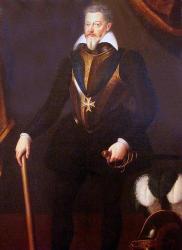
Sir George Rooke was an English naval commander born in 1650. His career began during the Anglo-Dutch Wars and the War of the League of Augsburg against France. In January 1689, he participated in the Siege of Londonderry, where he played a crucial role in transporting reinforcements and supplies despite French naval opposition.
Battle of Beachy Head and La Hogue
In 1690, Rooke fought in the Battle of Beachy Head against the French fleet led by Admiral Tourville. He also played a significant part in the decisive Battle of La Hogue in 1692, where he commanded a squadron that attacked and destroyed the French ships at La Hougue, effectively annihilating the French fleet.
War of the Spanish Succession
In 1702, Rooke led a British fleet to Cadiz, Spain, with the aim of capturing the vital port city. However, he failed to achieve his objective and instead turned his attention to the "silver fleet" anchored at Vigo. In October, Rooke attacked and defeated a French squadron, capturing or sinking most of the Spanish ships carrying precious cargo.
Capture of Gibraltar
In 1704, during the War of the Spanish Succession, Rooke continued to lead British naval operations against France and Spain. He was dispatched to retake Gibraltar, which had a weak garrison. After a bombardment and a successful landing assault, Rooke captured Gibraltar on August 4, 1704. This victory proved strategically important for Great Britain and became a cornerstone of its maritime empire.
Battle of Malaga
In August 1704, Rooke's Anglo-Dutch fleet engaged with the French fleet under the command of Admiral Toulouse near Malaga. The battle lasted for several hours, with neither side able to gain a decisive advantage. However, Rooke's fleet was unable to pursue the French, as many of his ships had expended their ammunition during the capture of Gibraltar.
Later Career and Legacy
Rooke was promoted to Admiral of the Fleet in 1696. He passed away in 1709 and was buried in Canterbury Cathedral. His exploits and contributions to British naval history are remembered through the imposing Gibraltar Rock itself. Rooke's name continues to be inscribed in the annals of British naval dominance and military prowess.