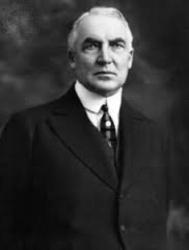
Jeyms Monroe
 USA
USABiography of James Monroe
Early Life
James Monroe was born on April 28, 1758, in Washington Parish, Westmoreland County, Virginia. He was the eldest son of Spence and Elizabeth Monroe. Unlike other influential politicians in Virginia, Monroe grew up on a small plantation of only 500 acres. He considered his father to be a "worthy and respectable citizen." Monroe attended a private school run by Pastor Archibald Campbell and later enrolled in the College of William and Mary in Williamsburg at the age of 16. As a student, he actively participated in the political conflicts between the colonies and the metropolis. With the onset of the Revolutionary War, he joined the Virginia regiment of the Continental Army and received his commission as an officer at the age of 18. He showed bravery and by 1778 had risen to the rank of major.
Political Career
Monroe's political career began in 1782 when he was elected to the Virginia House of Delegates. In the following years, he was sent to the Congress of the Confederation, which met in New York, and served until 1786. After trips to the Kentucky region and future Northwest Territories in 1784 and 1785, where he owned extensive estates acquired as payment for his service in the army during the Revolution, he gained significant influence in the development of Northwest Ordinance resolutions, acting as a mouthpiece for Thomas Jefferson, who was in Paris at the time. He was undoubtedly one of the enthusiastic supporters of the rapid and regulated settlement of the American West, which also contributed to the economic use of his own lands. This explains his opposition to John Jay's negotiations with Spanish envoy Don Diego de Gardoqui for a trade treaty with Spain, which threatened free navigation on the Mississippi River, acquired in the Treaty of Paris in 1783.
Alongside his intensive work in the Congress of the Confederation, which familiarized Monroe with all the problems of the young union, his long stay in New York had consequences for his personal life. On February 16, 1786, Monroe married Elizabeth Kortright, the daughter of a once wealthy but impoverished West Indies planter due to the Revolution. Their first daughter, named after her mother, was born in December of the same year. Monroe was not a member of the Philadelphia Constitutional Convention in 1787, but as a delegate to the Virginia State Convention, he belonged to the opponents of the Constitution. Here, his concern that the future federal government would sacrifice the interests of the West for the coastal regions may have played an important role. In the first congressional elections, Monroe lost to James Madison, but in 1790, the Virginia legislature sent him as a senator to Washington, where he remained until his appointment as American envoy to France four years later.
His activity in Paris was not particularly fruitful, primarily because his pro-French position, although in line with Vice President Thomas Jefferson and the evolving Republican Party, sharply contrasted with the neutral and even restrained behavior of President George Washington and his Secretary of State, Edmund Randolph. This was not surprising: while Washington, like his successor John Adams, kept his distance from revolutionary France, Monroe, by that time already one of the prominent leaders of the Republicans, tried to maintain mutual understanding between the two countries. His successor, Timothy Pickering, recalled Monroe on July 29, 1796, back to Washington, where he defended him in one of his letters. The sharp attacks from political opponents did not damage Monroe's political authority in his party or in Virginia. He was elected governor of Virginia in 1799 and held the position until 1802. After the election of his friend Jefferson as the third president of the United States, Monroe returned to Washington in 1801. The capital became the center of his political activity until 1809. Political missions took him to Paris in 1803, where he participated in negotiations with the French government for the purchase of Louisiana, then to Madrid, where he unsuccessfully tried to secure concessions from Spain regarding the eastern part of West Florida, and to London, where, together with William Pinkney in 1806, he tried without much success to resolve the sharp disagreements with the former metropolis. The result was so meager that President Jefferson, with the consent of his Secretary of State James Madison, refused to submit the treaty to the Senate for approval due to the lack of British concessions to cease the impressment of American sailors.
Monroe was so angered by this that upon his return in December 1807, he wanted to demonstrate his political position in Virginia and did not prevent his supporters in the Republican Party from nominating him as a presidential candidate against James Madison, who was under the patronage of Jefferson. He lost to him in 1808, just as he did in 1788. He did not receive a single vote in the Electoral College. Two years later, he was again in the Virginia House of Delegates, and in January 1811, he was re-elected as governor. At the same time, Monroe succeeded in reconciling Jefferson, Madison, and himself. In March 1811, the president appointed Monroe as the new Secretary of State, replacing Robert Smith. Relations with the United Kingdom defined James Monroe's activity as Secretary of State under Madison. In his efforts to resolve acute problems, such as the restriction of American navigation and, above all, the British demands to search American ships at sea for former British sailors, he also took over as Secretary of War in 1814. As Secretary of War, he claimed credit for American victories at Plattsburg and New Orleans. In the end, it was not these victories but the favorable peace in Ghent (ratified on February 17, 1815) that strengthened his political position and added weight to his claims for the presidency.
Presidency
Despite broad support from leading members of the Republican Party in Virginia and other states, Monroe only narrowly defeated William Crawford of Georgia, the Secretary of the Treasury under Madison, with 65 votes against 54 in a closed session of Congress in March 1816 when discussing the nomination of a presidential candidate from the Republican Party. Monroe was not afraid of the presidential elections. The Federalist Party was hopelessly divided, and its candidate Rufus King, naturally, had no chance. In the Electoral College on December 4, 1816, 183 votes were cast for Monroe, while King received only 34 votes. Among the presidents from Virginia, Washington, Jefferson, and Madison, James Monroe occupies a strange dual position. He shares a greater "down-to-earth" quality with George Washington. Like the first president, he was reserved, sometimes formal, and strived for politeness. In terms of education, lifestyle, and refined elegance, Thomas Jefferson was undoubtedly the most impressive personality among these illustrious presidents. However, Monroe's political views were more in line with those of Jefferson and Madison. While Jefferson actively sought to create a political entourage that would be united in close connection with the populist ideals of the American Revolution, Monroe, like Washington, held onto old beliefs that a politician should serve society but not strive to advance himself or create a circle of supporters. However, similarities can also be seen with Jefferson and Madison, as well as differences from Washington. These were rooted in politics. Like Jefferson and Madison, individual state rights were of great importance to Monroe. Therefore, in 1787-88, he belonged to the opponents of the federal Constitution, and as president, he could not bring himself to interpret the Constitution liberally at the expense of the powers of individual states. Like Jefferson, he viewed the French Revolution more as a continuation of the American Revolution than as a coup and chaos. While serving as an envoy in Paris, he hid Thomas Paine in his house. At the same time, he shared Jefferson's distrust of the former metropolis, a distrust that was reinforced by his own experiences during his time in England.
Monroe's eight-year presidency was long characterized as the "Era of Good Feelings." This definition primarily refers to the fact that Monroe's presidency was marked by a lack of party disputes. In reality, the Federalists and Republicans as organized political groups – whether they can truly be called parties in the modern sense is still debatable – lost their significance or, more precisely, dissolved into groups of politicians who formed around individual prominent figures like William Crawford or John Calhoun. In individual states such as Virginia or New York, political life was determined by fiercely competing factions. Below the level of official politics, which was characterized by politeness and publicly displayed harmony, this led to strong fragmentation and fierce competition, which intensified during Monroe's presidency due to growing sectional conflicts over tariffs and slavery. Faced with such developments, Monroe behaved passively. Believing that the president should stand above political parties, personal feuds, and factions, he did not exercise vigorous political leadership. He could not prevent the splitting into factions and rivalries that infiltrated his cabinet. By the end of his presidency, the country was torn apart by major problems of political and social coexistence.
Four major themes defined James Monroe's eight-year presidency: foreign relations with European powers and their colonial claims, especially in Latin America; domestic problems related to slavery; disagreements over external tariffs; and the question of the constitutionality of expanding the country's public transport system and overall infrastructure. At the beginning of his presidency, Monroe faced the consequences of his diplomatic activities under Presidents Jefferson and Madison: West Florida, the unresolved question of the western border with Spanish territories, and attitudes towards Spanish colonies in Latin America that had declared their independence but were still seeking recognition from European powers and the United States. In Europe, the countries of the Holy Alliance took on the role of intermediaries between Spain and its rebellious colonies to restore the previous state. With the exception of England, which showed great restraint, the recognition of Latin American states required a careful weighing of the consequences such a step could have for the Holy Alliance states. Monroe, as during his first mission to France, leaned towards a position that combined neutrality and friendliness towards the young republics. On the other hand, his Secretary of State John Quincy Adams regarded early recognition as dangerous, as it would complicate relations with the Holy Alliance and also did not believe in the stability of Latin American states. Henry Clay, a powerful Speaker of the House of Representatives and, along with Secretary of War John C. Calhoun and Secretary of the Treasury William Crawford, one of the most prominent political figures in Washington, firmly demanded swift recognition and support for the young states in their struggle for independence against Spain. The demand also assumed that the owners of pirate ships from these states would receive any support, although their attacks on European merchant ships would have seriously damaged American foreign relations. Clay's position was based on a vision of a great, united "American system" of continental American family of states, in which the first republic to emerge from the revolution would take the leading role.
In reality, the issues touched upon the question of America's own revolutionary self-understanding, and Monroe believed that this point of view influenced him. Adams, on the other hand, believed that the recognition of the states would complicate negotiations with Spain and worsen relations with the Holy Alliance. Monroe gave his Secretary of State full freedom in negotiations with Spain. The Transcontinental Treaty, signed by Monroe on February 24, 1819, and ratified by Spain with a significant delay, is appropriately called the Adams-Onís Treaty in research. The treaty settled the western border and ensured that the United States not only acquired all of Florida but, for the first time in international legal form, gained access to the Pacific Ocean through a broad strip of land south of the Columbia River.
Settling relations with former Spanish colonies, which had declared their independence but were still struggling for recognition from European powers and the United States, proved to be much more difficult. In Europe, the states of the Holy Alliance took on the role of intermediaries between Spain and its rebellious colonies, seeking to restore the previous state, with the exception of England, which showed great restraint. Recognizing the Latin American states simultaneously required careful consideration of the consequences such a step could have for the Holy Alliance states. Monroe, as he did during his first mission to France, leaned towards a position that combined neutrality and friendliness towards the young republics. His Secretary of State, John Quincy Adams, on the other hand, regarded early recognition as dangerous, as it would complicate relations with the Holy Alliance and did not believe in the stability of Latin American states. Henry Clay, a powerful Speaker of the House of Representatives and one of the most prominent political figures in Washington, along with Secretary of War John C. Calhoun and Secretary of the Treasury William Crawford, firmly demanded swift recognition and support for the young states in their struggle for independence against Spain. The demand also assumed that the owners of pirate ships from these states would receive any support, although their attacks on European merchant ships would have seriously damaged American foreign relations. Clay's position was based on a vision of a great, united "American system" of continental American family of states, in which the first republic to emerge from the revolution would take the leading role.
In reality, the issues touched upon the question of America's own revolutionary self-understanding, and Monroe believed that this point of view influenced him. Adams, on the other hand, believed that the recognition of the states would complicate negotiations with Spain and worsen relations with the Holy Alliance. Monroe gave his Secretary of State full freedom in negotiations with Spain. The Transcontinental Treaty, signed by Monroe on February 24, 1819, and ratified by Spain with a significant delay, is appropriately called the Adams-Onís Treaty in research. The treaty settled the western border and ensured that the United States not only acquired all of Florida but, for the first time in international legal form, gained access to the Pacific Ocean through a broad strip of land south of the Columbia River.