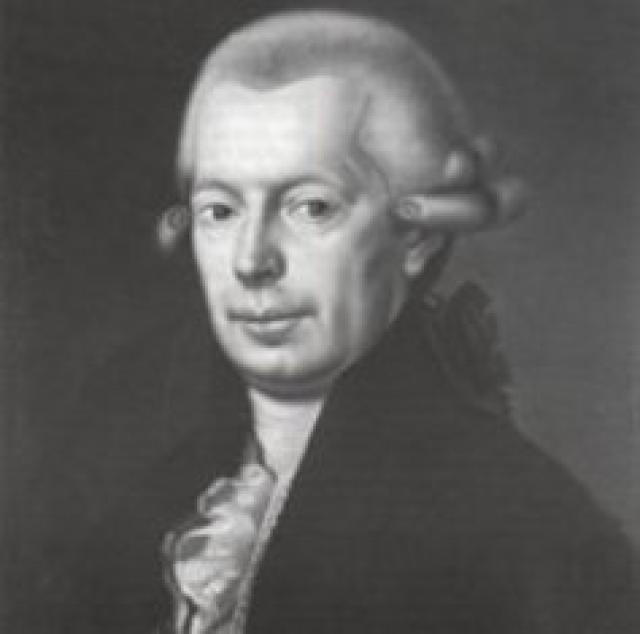
Johann Georg Albrechtsberger
 Austria
Biography of Johann Georg Albrechtsberger
Johann Georg Albrechtsberger was born on February 3, 1736, in Klosterneuburg, near Vienna, Austria. He initially studied music at Melk Abbey and philosophy at the Benedictine seminary in Vienna. Albrechtsberger became one of the most educated and skilled masters of counterpoint among his peers. He studied alongside Michael Haydn and Franz Joseph Aumann.
Early Career
Albrechtsberger served as an organist in Raab in 1755 and later in Maria Taferl in 1757. He then returned to Melk Abbey, where he led a small group of musicians. In 1772, Johann was appointed as an organist at the Viennese imperial court, and in 1792, he became the Kapellmeister of St. Stephen's Cathedral. Albrechtsberger had numerous students in the Austrian capital, some of whom went on to become prominent musicians, including Johann Nepomuk Hummel, Ignaz Moscheles, Ludwig-Wilhelm Tepper de Ferguson, Josef Weigl, and Antonio Casimir Cartellieri. Notably, Ludwig van Beethoven and Franz Xaver Wolfgang Mozart were also among his esteemed pupils.
Influence on Beethoven
Beethoven arrived in Vienna in 1792 to study with Joseph Haydn but quickly grew frustrated with the lack of attention and guidance on his compositions. Haydn then recommended Albrechtsberger to Beethoven, and the latter studied harmony and counterpoint with him. After completing his studies, the young student remarked that "patience, diligence, perseverance, and sincerity lead to success" after deeply contemplating Albrechtsberger's compositional philosophy. Interestingly, in a fit of anger, Beethoven once exclaimed that Albrechtsberger was incapable of doing anything properly.
Legacy and Works
Johann Georg Albrechtsberger passed away on February 3, 1736, in Vienna. His grave is located at St. Marx Cemetery. Although he composed preludes, fugues, sonatas for piano and organ, and works for string orchestras, a significant portion of his compositions, both vocal and instrumental, exist only in manuscript form. These manuscripts are housed in the Vienna Gesellschaft der Musikfreunde library. Around 1756, Albrechtsberger wrote at least seven lyre and string concertos, three of which are preserved in the Hungarian National Library in Budapest. These concertos are written in the "galant style." Arguably, the most valuable contributions of Albrechtsberger are his educational and theoretical works. In 1790, he published a scientific treatise on the art of composition in Leipzig, which saw its third edition in 1821. His collection of works dedicated to harmony, consisting of three volumes, was published by his student Ignaz von Seyfried in 1826. An English version appeared in 1855.
Johann Georg Albrechtsberger's compositional style was formed through his study of the counterpoint of Johann Joseph Fux, who served as the Kapellmeister of St. Stephen's Cathedral from 1713 to 1741, a position that Albrechtsberger would later assume 52 years later.


