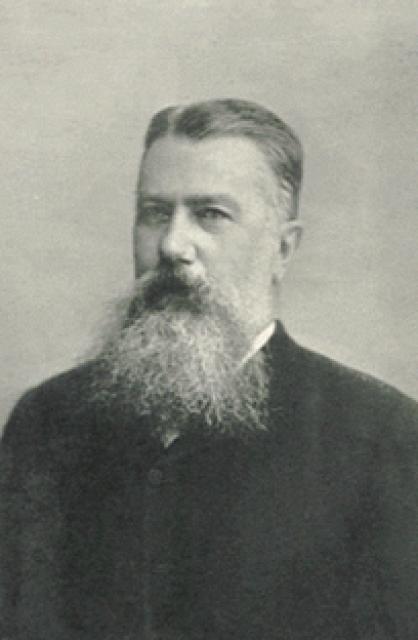
Johann Georg Buhler
 Germany
- Georg Bühler: A Renowned Indologist
- Travels and Research
- Appointment to India
- Professorship and Educational Reforms
- Literary Achievements
- Return to Europe and Legacy
Georg Bühler: A Renowned Indologist
Early Life and EducationGeorg Bühler was born on July 19, 1837, in Borstel, Hanover, Germany. He attended gymnasium in Hanover, where he studied Greek and Latin, before enrolling at the University of Göttingen to pursue theology and philosophy. At Göttingen, Bühler excelled in Sanskrit, Avestan, Persian, Armenian, and Arabic. In 1858, he earned a doctorate in Oriental languages and archaeology with a thesis on the suffix "-τάς" in Greek grammar.
Travels and Research
After completing his doctorate, Bühler traveled to Paris in 1858 and London in 1859 to study Sanskrit manuscripts. In London, he remained until 1862, diligently examining Vedic manuscripts at the Bodleian Library. In 1861, he was appointed Assistant Librarian to Queen Victoria's private library.
Appointment to India
In the fall of 1862, Bühler was appointed Assistant Librarian at Göttingen, where he received an invitation to join the Sanskrit College in Varanasi, India. He also received an invitation to become Professor of Oriental Languages at Elphinstone College in Bombay, which he eagerly accepted. Bühler arrived in Bombay on February 10, 1863.
Professorship and Educational Reforms
Over the next few years, Bühler made significant contributions to education in India. He became a Fellow of the Bombay University Senate and member of the Bombay Branch of the Royal Asiatic Society. In 1864, he was appointed Professor of Ancient History at Bombay University, and in 1866, Chief Inspector of Sanskrit Education at Deccan College in Pune.
In 1868, Bühler became the Inspector of Northern Division (Gujarat) and embarked on an ambitious project to locate and collect Sanskrit manuscripts, initially assisted by Kilhorn and later pursuing it solo from 1870. His work was highly successful, and he significantly expanded the collection of Indian and European libraries.
Literary Achievements
Bühler's scholarly pursuits extended beyond his administrative duties. In 1878, he published his translation of the "Paiyalacchhi," the oldest known Prakrit dictionary. He also contributed translations to Max Müller's monumental series, "The Sacred Books of the East," which sought to compile and translate ancient Indian texts.
Return to Europe and Legacy
In 1881, Bühler returned to Europe and took up the Chair of Sanskrit at the University of Vienna. He continued his research and published extensively until his tragic death on April 8, 1898, when he drowned in Lake Constance.
Georg Bühler's contributions to the study of ancient Indian languages, history, and law earned him international recognition. He is remembered as one of the foremost Indologists of his time, whose legacy continues to inspire scholars and students alike.