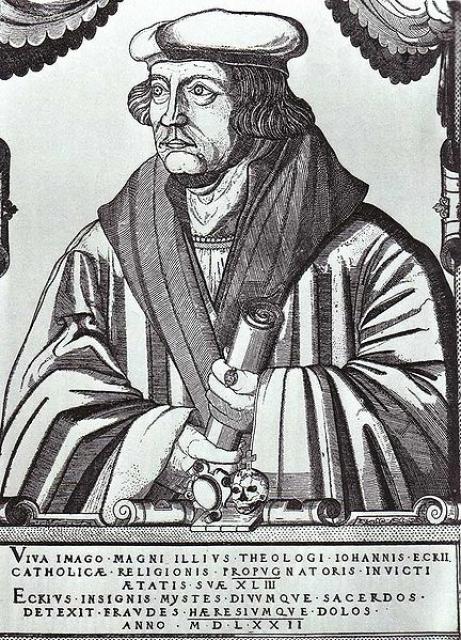
Johann Maier Eck
 Germany
Biography of Johann Maier Eck
Johann Maier Eck was a native of the town of Eck in Swabia and a prominent opponent of Martin Luther. He was known for his exceptional memory and extensive knowledge of canon law. Eck was also a skilled Latin speaker and a clever debater, often able to outwit his opponents in formal discussions. Despite his later opposition to Luther, Eck and Luther were friends in their youth.
Eck received his education at the universities of Tübingen, Heidelberg, and Cologne. He served as the chancellor of the University of Ingolstadt and held positions as a canon in the Eichstätt chapter and as an inquisitor for the Franconian and Bavarian Inquisition districts.
Known for his remarkable memory and expertise in canon law, Eck was a master of Latin rhetoric and was renowned for his ability to formally confound his opponents. He achieved numerous victories in scholarly debates at eight different universities.
When Martin Luther published his theses in 1517, Eck wrote a letter to the bishop of Eichstätt, stating that Luther's teachings were tainted with Bohemian poison, which referred to the heresy of Jan Hus. This letter, titled "Obelisks," was published by Eck in 1518. In response, Luther wrote "Asterisks."
In the fall of 1518, Eck met Luther and promised to oppose Andreas Karlstadt, who was defending Luther. The Leipzig Debate was chosen as the venue for this dispute. However, Eck once again offended Luther in a pamphlet published against Karlstadt. As a result, Luther decided to attend the debate himself.
The famous Leipzig Debate took place first between Eck and Karlstadt, starting on June 28, 1519, and later between Eck and Luther. Eck's booming voice, self-assurance, lack of doubt, resourcefulness, and composure left a strong impression. He skillfully set a trap for Luther. The Leipzig professors sided with Eck, claiming that he had defeated Luther and Karlstadt.
Before leaving Leipzig, Eck wrote a letter to Elector Frederick in which he referred to Luther and Karlstadt as dangerous heretics. Luther responded to this letter. Eck demonstrated a lack of tact by personally bringing the papal bull of excommunication against Luther to Germany in 1520, which displeased Frederick the Wise, who refused to publish it.
At the Diet of Worms in 1521, Eck served as the prosecutor for the ecclesiastical court. He read out the titles of Luther's books and pamphlets and asked if Luther acknowledged himself as the author of these works. Eck also opposed the Augsburg Confession and participated in drafting the Confutation, which even displeased Emperor Charles V due to its sharp tone. He was involved in attempts to reach a peaceful agreement with the Protestants at the meetings in Worms (1540) and Regensburg. Additionally, he published his own translation of the New Testament.



