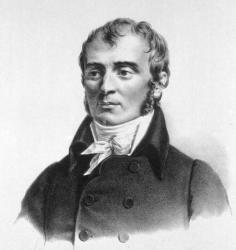
Johann Reil
 Germany
Johann Christian Reil: The German Physician, Physiologist, Philosopher, and Educator
Johann Christian Reil was a German physician, physiologist, philosopher, and educator who coined the term "psychiatry" and established the concept of a "hospital for mental therapy" (psychiatric hospital). He also founded the first scientific journal dedicated to physiology and the first German psychiatric journal. Reil made significant contributions to the understanding of the structure and chemical composition of the brain, heart, and fingers.
Early Life and Education
Johann Christian Reil was born as the only son of Lutheran pastor Johann Julius Reil and Anna (née Jensen-Streng) in the region of East Frisia. Although his father wanted him to become a pastor, Reil was more interested in medicine than theology. In October 1788, he married Johanna Wilhelmine Leveo, the daughter of wealthy Huguenot parents. They had two sons and four daughters.
Reil studied in Göttingen in 1779 for three semesters and then, starting from October 14, 1780, in Halle under the guidance of Professor of Medicine F.F.T. Meckel (father of J.F. Meckel the Younger) for surgery and anatomy and I.F.G. Goldhagen for medicine. Goldhagen himself accepted his student as a master of the Masonic lodge "Zu den Drei Schwertern" ("To the Three Swords") on March 1, 1782. After receiving his medical and surgical doctorate by defending a dissertation on diseases of the biliary system on November 9, 1782, Reil completed the required internship courses for approval as a Prussian physician in the University of Medicine and Surgery in Berlin in the same year. This was the best university in Prussia at that time. He lived here with Henrietta and Marcus Herz, to whom he arrived with a letter of recommendation from Goldhagen. Marcus was a physician, and Johann Christian was impressed by his combination of Enlightenment teachings, Kantian philosophy, medicine, and science. Moreover, he was a student of Kant himself, and it was he who influenced Reil's philosophical worldview.
Medical Career and Early Scientific Works
Reil worked as a private physician in the northern part of the country for four years from 1783. During this time, he wrote a practical guide titled "Dietary Advice for the Domestic Physician for my Compatriots" in 1785. In 1787, thanks to Goldhagen, who invited him as a lecturer, he was appointed as an adjunct professor of medicine at the University of Halle. After the sudden death of his mentor and predecessor I.F.G. Goldhagen, Johann Christian Reil became a professor of therapy and hospital director in 1788 and was appointed as a city physician in 1789. Reil taught in Halle for 21 years. In 1793, he became a member of the oldest Leopoldina Academy, though he was never invited to the Berlin Academy. In 1802, he declined a generous offer to teach in Göttingen, instead accepting a salary of 900 thalers and the title of Senior Supreme Councilor in Halle. One of his major works was "On Accumulated Experience and Treatment of Fever" (5 volumes, Halle 1799-1815). One of its main achievements was the understanding that fever is a universal reaction of the body to various diseases, characterized by an increase in temperature.
Introduction
German philosophers of the 18th and early 19th centuries were idealists, and religion found support among them. This was reflected primarily in German pedagogy (where Reil would later make his mark) and in the psychiatry of the first half of the 19th century, which was dominated by religious-moralizing views on mental illness. The idealist philosophers of that time, acknowledging the primacy of the mind, contributed to the emergence of dualism in psychiatry, which led to the formation of two ideological schools: the "psychic" and the "somatic." The prevalent "psychic" school believed that mental illness was a result of a sick soul and that sin was its source. They were opposed by the "somatic" schools, who believed that the soul is immortal and cannot become ill; it is the physical body that becomes ill, serving as the basis and cause of mental disorders. Convinced of pointing the true path to the mentally ill, they contributed to the spread of a whole range of mechanical devices. They also influenced Johann Christian Reil and found their development in his ideas.