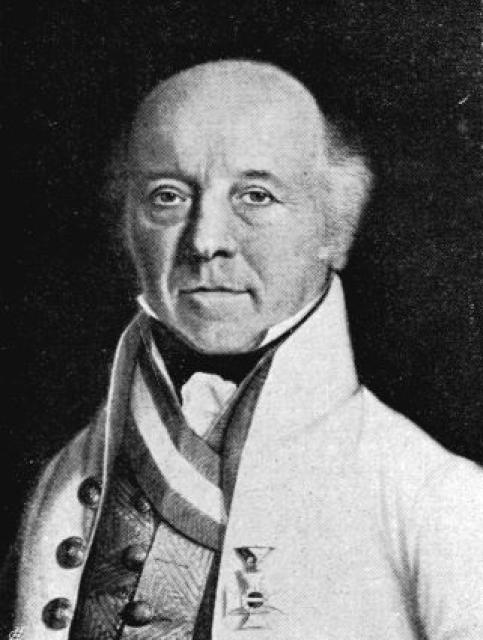
Johann von Hiller
 Austria
- Birth and Early Career
- Military Campaigns and Distinctions
- Advancement and Leadership
- Clash with Archduke Charles and Later Career
- Post-War Life and Legacy
Birth and Early Career
Baron Johann von Hiller, an Austrian general and artillery commander, was born on June 10, 1754, in Brody, Galicia. His father was a colonel in the Austrian army, and Hiller joined the service in 1770 as a member of the 8th Infantry Regiment.
Military Campaigns and Distinctions
During the War of the Bavarian Succession (1778-1779), Hiller distinguished himself in battle. Later, in the 1788-1791 conflict against the Ottomans, he fought under the command of Field Marshal Ernst Gideon von Laudon and earned the prestigious Order of Maria Theresa for his bravery during the assault on Novi. By 1789, he had risen to the rank of colonel and became Laudon's adjutant in 1790.
In 1794, Hiller was promoted to the rank of major general and fought in Italy during the First Coalition War. From 1796 onwards, he led a brigade as part of the Army of the Rhine. During the Second Coalition War, he again participated in the Italian campaign and earned further recognition at the Battle of Zurich in 1799. He subsequently served in the Netherlands.
Advancement and Leadership
By early 1805, Hiller had been promoted to lieutenant field marshal and was entrusted with the command of troops in Tyrol and Vorarlberg. He distinguished himself in engagements during the War of the Third Coalition.
In the 1809 campaign, Hiller emerged as a brilliant commander. Leading the 6th Army Corps, he forced a retreat of the enemy forces at Neufahrn an der Isar but was eventually defeated by Napoleon at Landshut. However, Hiller's successful defense against pursuing French divisions at Neumarkt earned him a Commander's Cross of the Order of Maria Theresa.
Despite his efforts, the superior French forces continued their advance, and Hiller retreated to Linz and subsequently to Amstetten. He bravely resisted Massena's attacks on May 3 but was compelled to abandon his position due to the threat of his army being outflanked.
Clash with Archduke Charles and Later Career
On May 13, Hiller fought against Marshal Jean Lannes at the Battle of Ebersberg, and shortly after, he joined forces with Archduke Charles. In the Battle of Aspern-Essling on May 20-21, Hiller led the Austrian right wing and achieved significant success, but his request to pursue the retreating enemy was denied. A subsequent dispute with Archduke Charles led to Hiller's departure from the army, officially attributed to "a sudden and severe illness."
In 1813, Hiller commanded the Army of Inner Austria, later renamed the Italian Army, embarking on a campaign to conquer Illyria. His forces drove the enemy from a strong position at Tarvis and advanced into Italy. Hiller was recalled to the main army in December, and Count Johann von Bellegarde assumed command of the Italian Army.
Post-War Life and Legacy
After the Treaty of Paris, Hiller was appointed Commander-in-Chief in Transylvania and later in Galicia. He also served as President of the Military Tribunal in Lviv. He died in Lviv on June 5, 1819, at the age of 65.
Throughout his career, Hiller enjoyed immense popularity within the Austrian army, and later historians have compared him to Field Marshal Joseph Radetzky, another renowned Austrian general.