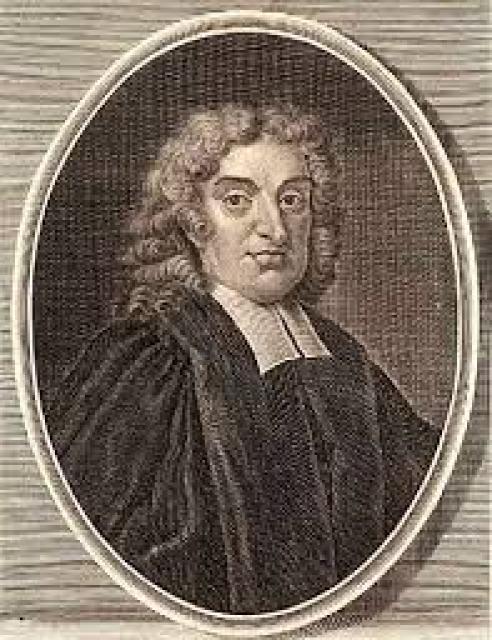
John Flamsteed
 Great Britain
- John Flamsteed, the Pioneer of British Astronomy
- Contributions to Astronomy:
- Director of the Greenwich Observatory:
- Instrumental and Observational Innovations:
- Celestial Treasury: Historia Coelestis Britannica
- Other Scientific Contributions:
- Legacy and Impact:
John Flamsteed, the Pioneer of British Astronomy
Birth and Early Education:John Flamsteed was born on August 19, 1646, in Denby, Derbyshire, England. His fascination with astronomy began at the tender age of 16. With a small telescope, he embarked on the meticulous task of charting the precise positions of stars, planets, and the Sun.
Contributions to Astronomy:
Flamsteed's reputation within the scientific community soared due to his accurate calculations of eclipses and lunar occultations. In 1670, he joined the University of Cambridge, where he obtained his Master's degree in 1674.
Director of the Greenwich Observatory:
In 1675, under the patronage of King Charles II, Flamsteed became the first Royal Astronomer and Director of the newly established Greenwich Observatory. There, he initiated systematic observations of the planets, Moon, and Sun. His tireless efforts led to the revision of their theories of motion and the development of ephemerides.
Instrumental and Observational Innovations:
Despite his fragile health, Flamsteed actively participated in designing and constructing astronomical instruments. With remarkable precision, he determined the obliquity of the ecliptic, the position of the equinoxes, and the right ascensions of stars. He refined the theories of lunar, Jupiterian, and Saturnian motions.
Celestial Treasury: Historia Coelestis Britannica
Flamsteed's magnum opus, Historia coelestis Britannica, presented his comprehensive observations. The third volume of this work, the renowned British Catalogue, published posthumously in 1725, cataloged the positions of 3000 stars. Flamsteed assigned sequential numbers to the stars within each constellation, a notation still prevalent today (e.g., 61 Cygni).
Other Scientific Contributions:
Beyond his celestial studies, Flamsteed authored tables of atmospheric refraction and tides. He also devised the conical projection in cartography.
Legacy and Impact:
John Flamsteed died in London on December 31, 1719, leaving an enduring legacy as one of the foundational figures of British astronomy. His meticulous observations and contributions to celestial mapping continue to serve as valuable resources for astronomers today.


