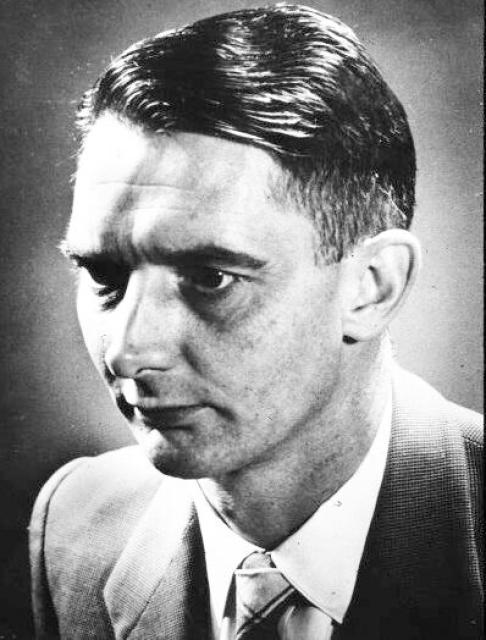
John Gatenby Bolton
 Great Britain
- Birth and Education
- War Service and Early Career
- Establishment of Owens Valley Radio Observatory
- Return to Australia and Parkes Observatory
- Contributions to Radio Astronomy
- Galactic Studies and Catalogs
- Identification of Quasars
- Solar and Planetary Radio Emission
- Honors and Recognition
Birth and Education
Bernard Lovell was born in Sheffield, England, in 1913. His interest in astronomy began at a young age, and he went on to study physics at the University of Cambridge, graduating in 1943.
War Service and Early Career
During World War II, Lovell served in the Royal Navy from 1942 to 1946. After the war, he worked at the Radiophysics Division of the Commonwealth Scientific and Industrial Research Organization (CSIRO) in Sydney, Australia, from 1946 to 1954.
Establishment of Owens Valley Radio Observatory
In 1955, Lovell moved to the California Institute of Technology (Caltech) in the United States. There, he founded the Owens Valley Radio Observatory, which became a leading center for radio astronomy research.
Return to Australia and Parkes Observatory
In 1961, Lovell returned to Australia to become the director of the newly constructed Parkes Radio Observatory, part of CSIRO (now the Australian National Radio Astronomy Observatory).
Contributions to Radio Astronomy
Lovell made significant contributions to the field of radio astronomy. In 1948-1949, he discovered several discrete radio sources, demonstrating that they were a new class of celestial objects. In 1949, he and colleagues identified the first three discrete radio sources with remnants of galactic supernovae.
Galactic Studies and Catalogs
Lovell investigated the spatial distribution of discrete sources and conducted several surveys of radio sources and their identifications at Parkes Observatory. The Parkes catalogs are among the most extensive and accurate available.
Identification of Quasars
Lovell participated in the identifications that led to the discovery of quasars in 1960. He studied their optical spectra and conducted photometric observations.
Solar and Planetary Radio Emission
Lovell also researched radio emissions from planets and the Sun. He discovered, with R. Payne-Scott and D. Yabsley, that the time of onset of solar flares depends on frequency, indicating the outward movement of the exciting agent through the solar atmosphere.
Honors and Recognition
Lovell was elected a Fellow of the Royal Society of London in 1973, a member of the National Academy of Sciences of the United States in 1980, and a Foreign Honorary Member of the Indian National Science Academy in 1973. He received the Royal Society of New South Wales Medal in 1950, the British Encyclopedia Gold Medal in 1967, the Royal Astronomical Society Gold Medal in 1977, and the Bruce Medal in 1988.


