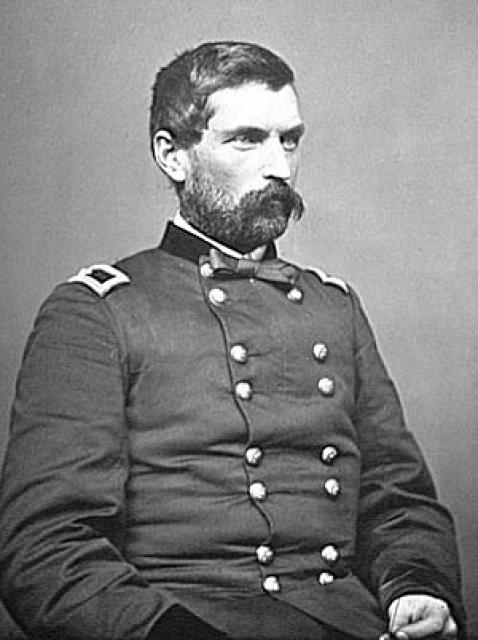
John Gibbon
 USA
USA- John Gibbon: A Military Career of Distinction
- Mexican-American War and Subsequent Service
- The Civil War
- The "Iron Brigade"
- Battle of Antietam and Gettysburg
- Overland Campaign and Siege of Petersburg
- Command of XVIII and XXIV Corps
- Post-War and Indian Wars
- Battle of the Big Hole
- Later Career and Death
- Legacy
John Gibbon: A Military Career of Distinction
Early Life and Military EducationJohn Gibbon, born on April 20, 1827, in Holmesburg, Pennsylvania, was a fourth child of ten born to Dr. John Heysham Gibbon and Catherine Lardner. After his early childhood in the Philadelphia area, his family moved to Charlotte, North Carolina, where his father became the U.S. Mint's Chief Coiner. Gibbon received primary education before enrolling at the United States Military Academy at West Point in 1843. He graduated 20th in the Class of 1847 and was commissioned as a brevet second lieutenant in the 3rd U.S. Artillery.
Mexican-American War and Subsequent Service
Gibbon served in Mexico during the Mexican-American War, but did not see combat. He later contributed to peacekeeping efforts between Seminoles and settlers in South Florida during the Seminole Wars. As an instructor in artillery tactics at West Point, Gibbon authored "The Artillerist's Manual" (1859), a seminal work on artillery gunnery used by both sides during the Civil War. On September 12, 1850, he was promoted to first lieutenant and on November 2, 1859, to captain. In 1855, he married Frances "Fannie" North Moale. They had four children: Frances Moale Gibbon, Catherine "Katie" Lardner Gibbon, John Gibbon Jr. (died in infancy), and John S. Gibbon.
The Civil War
Выбор UnionAt the outbreak of the Civil War, Gibbon was serving as a captain in Battery B, 4th U.S. Artillery, stationed at Camp Floyd, Utah. Despite his father being a slave owner and three brothers and a cousin serving in the Confederate Army, Gibbon chose to serve the Union. Upon arriving in Washington, he became Chief of Artillery in McDowell's Army.
The "Iron Brigade"
In 1862, Gibbon was promoted to brigadier general of volunteers and commanded the "King's Wisconsin Brigade," also known as the "Black Hat Brigade" for its signature headgear. Gibbon led the brigade at the Second Battle of Bull Run, where it earned its moniker "Iron Brigade" for its fierce defense of South Mountain.
Battle of Antietam and Gettysburg
At Antietam, Gibbon's brigade was part of Hooker's Corps. It played a significant role in breaking through enemy lines on the Cornfield. In the Battle of Gettysburg, Gibbon commanded the 2nd Division of II Corps and temporarily assumed command of the entire corps in place of Winfield Scott Hancock. His division faced the brunt of Pickett's Charge, and Gibbon was wounded.
Overland Campaign and Siege of Petersburg
Gibbon returned to duty and led the 2nd Division of the Second Corps (Hancock's). At the Battle of the Wilderness, his division halted enemy advances and prevented a complete corps collapse. However, he faced scrutiny for allegedly failing to press an attack as ordered by Hancock. During the Siege of Petersburg, Gibbon's men refused to advance during the Second Battle of Ream's Station, plunging Gibbon into depression.
Command of XVIII and XXIV Corps
Gibbon commanded the XVIII Corps for a period, then briefly left service due to health reasons. However, he returned to take command of the XXIV Corps in the Army of the James. His corps played a key role in breaking through Confederate defenses at Petersburg and cutting off General Lee's escape route at Appomattox. Gibbon was one of three generals who accepted the surrender of the Army of Northern Virginia.
Post-War and Indian Wars
Colonel and Sioux CampaignAfter the war, Gibbon remained in the army. He reverted to the rank of colonel and commanded infantry at Fort Ellis, Montana, during the Sioux Wars of 1876. He assisted in the rescue of survivors of the Battle of Little Bighorn.
Battle of the Big Hole
In 1877, Gibbon was tasked with intercepting the Nez Perce retreating from Idaho. He engaged them at the Battle of the Big Hole, where his force suffered heavy casualties, including Gibbon himself. General Oliver Howard arrived the next day and pursued the Nez Perce, whom Gibbon was unable to assist due to his injuries.
Later Career and Death
John Gibbon died in Baltimore, Maryland, and was buried in Arlington National Cemetery. Besides "The Artillerist's Manual," he authored "Personal Recollections of the Civil War" (published posthumously in 1928) and "The Adventures of a Frontier Soldier" (posthumously, 1994). He also contributed numerous articles to newspapers and magazines, mainly on his experiences in the West and government policies toward Native Americans.
Legacy
In recognition of his service, a bronze statue of Gibbon was erected on the Gettysburg battlefield on July 3, 1988, marking the 125th anniversary of the battle. Towns in Minnesota and Oregon were named after him, as were the Gibbon River and Gibbon Falls in what is now Yellowstone National Park.