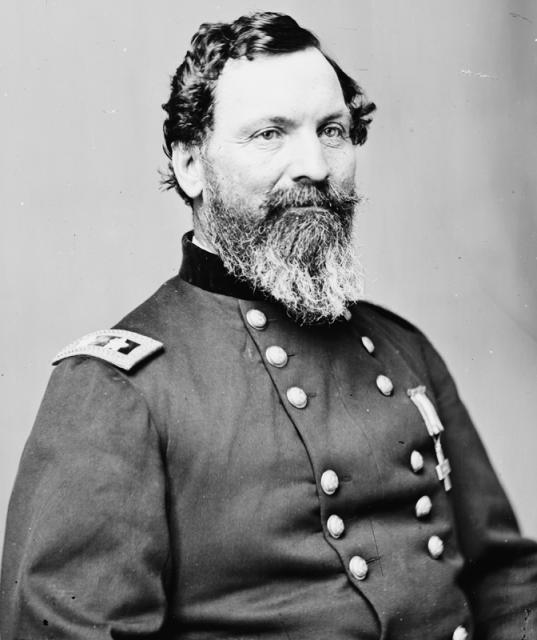
John Sedgwick
 USA
USA- John Sedgwick: American Civil War General
- Military Career before the Civil War
- Civil War Service
- Death at Spotsylvania
John Sedgwick: American Civil War General
Early Life and EducationJohn Sedgwick, a distinguished American soldier and educator, was born in Cornwall Hollow, Connecticut. He briefly attended The Sharon Academy in Vermont and then embarked on a teaching career for two years. In 1837, he graduated from the United States Military Academy at West Point.
Military Career before the Civil War
Upon graduating from West Point, Sedgwick was commissioned into the artillery. He participated in the Second Seminole War and the Indian Removal Act in the 1830s. He also earned two brevet promotions during the Mexican-American War.
Civil War Service
During the American Civil War, Sedgwick rose through the ranks of the Union Army, primarily with the Army of the Potomac. He commanded divisions and corps, earning the affectionate nickname "Uncle John" from his troops.
In 1861, Sedgwick took command of a division after General Charles Stone was arrested. He fought in the battles of Yorktown and Seven Pines during the Peninsula Campaign. During the campaign's Seven Days' Battles, Sedgwick was wounded at the Battle of Frayser's Farm.
At the Battle of Antietam in September 1862, Sedgwick's division was heavily attacked from three sides. Sedgwick was wounded three times and sidelined until after the Battle of Fredericksburg in December 1862.
During the Chancellorsville Campaign of 1863, Sedgwick played a pivotal role in General Hooker's campaign. His corps captured the heights of Marye's Hill but was stopped at Salem Church and retreated.
At the Battle of Gettysburg, Sedgwick's troops were held in reserve, but he later achieved a notable victory at the Battle of Rappahannock Bridge.
Death at Spotsylvania
On May 9, 1864, at the beginning of the Battle of Spotsylvania, Sedgwick was overseeing the placement of his artillery brigades. Confederate sharpshooters began firing at Sedgwick's position from 900 yards away. Sedgwick's men began to duck behind cover, fearing they would be hit by sniper fire.
Sedgwick, in an attempt to shame his officers, said that the Confederate sharpshooters could not hit an elephant at that distance. However, he immediately fell backward with a bullet wound to his head. The sniper's bullet had entered just below Sedgwick's left eye, killing him instantly. He was buried in his hometown of Cornwall Hollow, Connecticut.


