John Zonaras
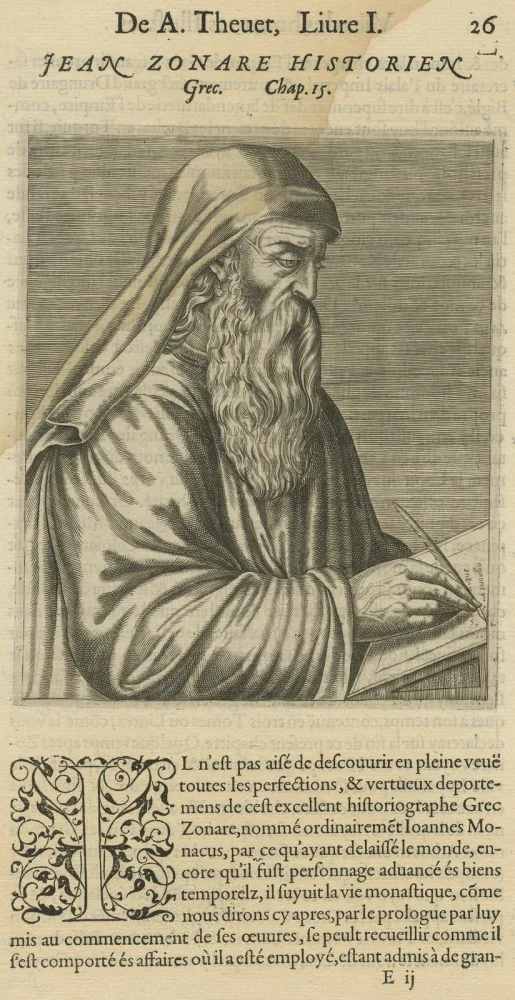
John Zonaras was a Byzantine historian, church writer, and legal scholar whose vast chronicle carried readers from the biblical creation story to the political world he had known. His Epitome of Histories is both a compilation of earlier authors and a pointed account of the empire under Alexios I Komnenos, the ruler whose reign brought Zonaras’s narrative to its close.
From imperial service to monastic life
Zonaras lived in the late eleventh and twelfth centuries, probably in Constantinople. Details of his early life are scarce, but he rose to high office in the Byzantine administration. Sources associate him with senior court and imperial service under Alexios I, including work in the imperial chancery.
After Alexios’s death in 1118, Zonaras withdrew from public life and entered a monastery, traditionally identified as St. Glykeria on an island near Constantinople. There he devoted himself to scholarship and writing. His career gave him first-hand experience of the court, while monastic life placed him in the scholarly world of the church.
The Epitome of Histories
Zonaras’s best-known work, the Epitome of Histories, is a sweeping history arranged in eighteen books. It begins with the creation of the world, recounts Jewish and ancient Greek history, and then follows Rome and the Byzantine Empire. The surviving narrative ends with Alexios I’s death in 1118.
The Epitome draws on a wide range of earlier writers, including Josephus, Plutarch, and Roman historians. Zonaras did more than copy them: he selected, condensed, and commented on their accounts for a medieval audience. His treatment of Alexios is notably critical, reflecting his own political judgments as well as a broader debate about imperial authority and government.
For historians, the chronicle preserves material that is otherwise lost or incomplete. Zonaras’s use of the Roman historian Cassius Dio is especially valuable for parts of Roman history, while his account of the later empire offers a perspective shaped by a former insider who had become a monk.
A scholar beyond the chronicle
Zonaras also wrote on canon law and theology. His legal works became part of the Byzantine tradition of interpreting church rules, and his writings show the range of learning expected of a senior cleric and scholar. The combination of historical, legal, and theological work made him one of the more versatile Byzantine authors of his period.
Legacy
Zonaras’s life bridged the imperial court and the monastery, and his work preserved centuries of history for readers who came after him. The Epitome remains important not only as a record of earlier sources but also as a crafted interpretation of power, empire, and the past. Its final chapters retain the voice of a historian who had watched the Byzantine political world from close range.