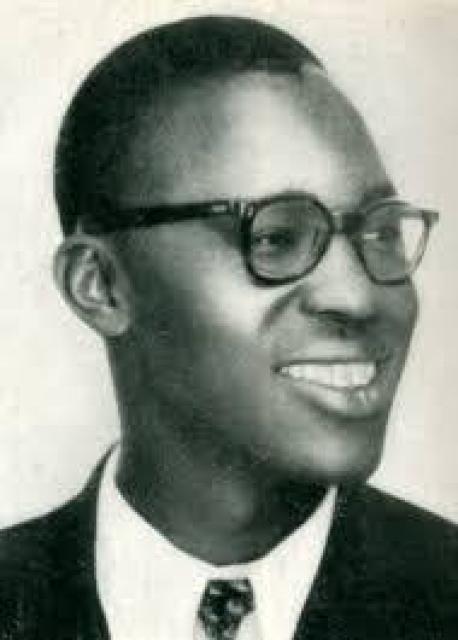
Joseph Conombo
 Burkina Faso
- Medical training and wartime service
- A political career across two governments
- Prime minister of Upper Volta
- Later life and legacy
Joseph Conombo was a Burkinabè physician, soldier and statesman whose career spanned French colonial rule, the creation of an independent Upper Volta and the country’s return to constitutional government in the late 1970s. Born on 9 February 1917 in Combissiri, south of Ouagadougou, he became one of the first politicians from Upper Volta to hold senior posts in both French and national governments. He died on 20 December 2008 in Nazougma.
Medical training and wartime service
The son of a farmer, Conombo studied at École normale William-Ponty in Gorée before entering the African School of Medicine and Pharmacy in Dakar in 1938. He received his medical qualification in 1942. During the Second World War, he served as a military doctor in the French colonial forces. His service took him through campaigns in Morocco, Corsica, Provence, Alsace and Germany, and he received the Croix de guerre. After demobilization, he returned to Upper Volta and worked as chief physician at the hospital in Batié.
A political career across two governments
Conombo entered public life in the mid-1940s, joining the Union Voltaïque, a party that supported restoring Upper Volta as a separate territory after it had been divided among neighboring French colonies. In 1948 he became a councillor of the French Union. Elected to the French National Assembly in 1951, he represented Upper Volta until 1959. He also served in the government of Prime Minister Pierre Mendès France: first as secretary of state for the interior in 1954, then in a post dealing with economic affairs and the French Union in early 1955.
As Upper Volta moved toward independence, Conombo continued to combine medicine and politics. He served as mayor of Ouagadougou in the early 1960s and later held public-health responsibilities. He became foreign minister in 1971 and remained in the post until 1974. He returned to the National Assembly after the 1970 election and became a prominent figure in the Union Démocratique Voltaïque, the country’s governing political movement.
Prime minister of Upper Volta
On 7 July 1978, the National Assembly elected Conombo prime minister of the Third Voltaic Republic, with 29 votes in favor, one against and 27 abstentions. The appointment placed a civilian politician at the head of government under President Sangoulé Lamizana, after a new constitution and elections had reopened parliamentary politics. Conombo held the office until 25 November 1980, when a military coup led by Saye Zerbo overthrew Lamizana’s government.
Following the coup, Conombo was detained for several years. The country was still called Upper Volta during his premiership; it adopted the name Burkina Faso in 1984.
Later life and legacy
Conombo’s life connected military service, medicine and public office across a period of major change in West Africa. His memoir, *Souvenirs de guerre d’un “tirailleur sénégalais”*, published in 1989, recounted his wartime experience in the French colonial forces. His long political career—from representation in French institutions to leadership of an independent republic—made him a distinctive figure in Upper Volta’s transition from colonial rule to national government.


