Joseph-Desire Mobutu
 Morocco
- Early Life and Military Career
- Political Career and Presidency
- Nationalization and Political Parties
- Challenges and Economic Crisis
- The Fall of Mobutu
- Death and Legacy
Joseph-Desire Mobutu: Biography of the President of the Democratic Republic of Congo
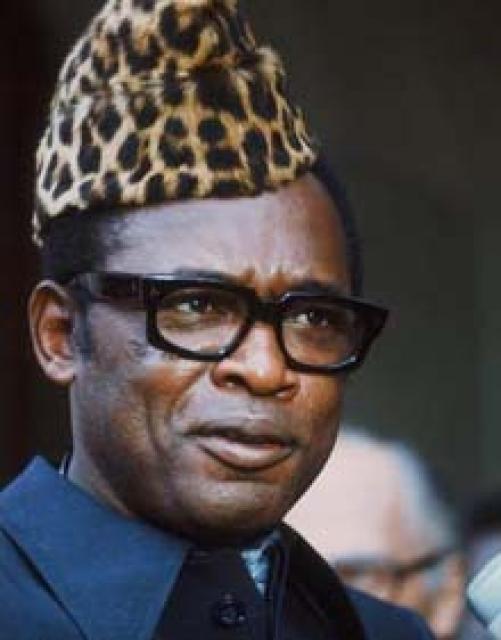
Joseph-Desire Mobutu, born on October 14, 1930, in the small town of Lisala in northeastern Belgian Congo, was the President of the Democratic Republic of Congo from 1965 to 1997. He was a Zairian military and politician who rose to power through a series of military and political events.
Early Life and Military Career
As a child, Mobutu was adopted by a Belgian missionary cook, which enabled him to attend a missionary school. At the age of 19, he was called up to serve in the army and rose to the rank of sergeant. After being demobilized in 1956, he pursued a career in journalism and gained popularity among educated Congolese.
Political Career and Presidency
When the Republic of Congo gained independence in June 1960, Mobutu was appointed as the Secretary of State for Defense. Within a week, the army revolted against Belgian officers, and Mobutu became the Chief of Staff, gaining control over most of the armed forces. Over the next five years, he played a significant role in military and political events.
In September 1960, Mobutu successfully navigated a political deadlock and transferred power to a government he formed. In 1965, during a similar crisis, he was made President by senior military officers. In the early years of his rule, Mobutu enjoyed popular support. He banned political parties, restored strong central authority, and reorganized the governance system.
Nationalization and Political Parties
Despite maintaining close ties with the West, Mobutu's government nationalized the giant mining company Union Minière du Haut-Katanga (UMHK) in 1967. In the same year, he established his own political party, the Popular Movement of the Revolution (MPR). In 1970, Mobutu ran as the sole candidate in presidential elections and won.
In 1971, Mobutu renamed the country Zaire, changed his Christian name to an African one, Mobutu Sese Seko, and proclaimed the ideology of "authenticity" or "authentic Zairian nationalism." During the mid-1970s, Mobutu pursued a pro-Western foreign policy while also developing relations with China.
Challenges and Economic Crisis
In 1975, an economic crisis hit the country. Efforts by the international community to liberalize Zaire's political system and stabilize the economy failed due to resistance from Mobutu and his inner circle. In 1980, thirteen members of parliament broke away from Mobutu and formed a new democratic movement, demanding a multiparty democratic system.
In 1982, this group openly challenged the one-party regime by creating the Union for Democracy and Social Progress (UDPS), which was legalized in 1990 when Mobutu announced the end of one-party rule and the beginning of a new era of multiparty system. However, Mobutu managed to undermine the reforms, blocking the implementation of the transitional plan agreed upon at the Independent National Conference in 1992.
The Fall of Mobutu
In the early 1990s, genocide and social tensions in Rwanda led hundreds of thousands of refugees to seek shelter in eastern Zaire. Zairian troops expelled not only the refugees but also ethnic Tutsis from the territory. In October 1996, Tutsi rebels and dissatisfied Zairians joined forces in the Alliance of Democratic Forces for the Liberation of Congo, led by Laurent Kabila.
They captured major cities in eastern Zaire and advanced towards the west, conquering vast territories. In May 1997, the rebel forces entered Kinshasa, and Mobutu fled the country. Kabila declared himself president and renamed the country the Democratic Republic of Congo. Mobutu was denied asylum in France and was only allowed to stay briefly in Togo. He eventually found refuge in Morocco.
Death and Legacy
Mobutu died in Rabat, Morocco, on September 7, 1997. His reign was marked by economic collapse, political repression, and ethnic tensions. Despite his initial popularity, Mobutu's legacy is one of authoritarian rule, corruption, and the deterioration of the Congolese state.