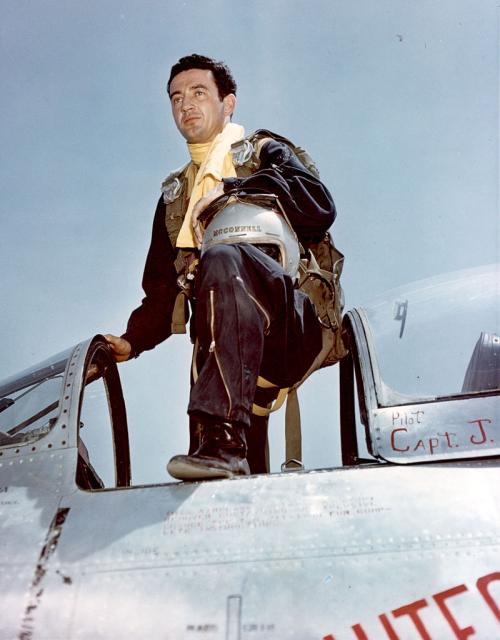
Joseph Makkonell
 USA
USABiography of Joseph McConnell
Joseph McConnell, an American Air Force captain and fighter pilot, was born on January 30, 1922, in Dover, New Hampshire. From a young age, he dreamed of becoming a pilot. During World War II, he joined the military aviation but was assigned to the bomber squadron instead of the fighter squadron he desired. As a navigator on a B-24 bomber, McConnell flew numerous combat missions in Europe. After the war, he finally achieved his goal when he was transferred to the fighter squadron in 1948.
When the Korean War broke out in 1950, McConnell immediately volunteered for duty in the conflict. Despite being considered too old for a fighter pilot at almost 30 years old, McConnell managed to overcome the obstacles. In August 1952, he was assigned to the 39th Fighter-Interceptor Squadron of the 51st Fighter Wing, based in South Korea. In the early months of his service, he did not encounter any enemy MiG aircraft, although he, along with other pilots, flew near Chinese airspace in the hope of engaging enemy planes near their bases. On January 14, 1953, McConnell shot down his first MiG-15, marking the beginning of his success.
During his service in Korea, McConnell flew three different F-86 fighter jets, all of which were named "Beautious Butch," a nickname inspired by his wife, Pearl Brown. In January 1953, he shot down four enemy aircraft, one in February, and two in March. On April 12, he was shot down for the only time in his career while providing cover for a raid on a hydroelectric station in Supho, China. His plane was hit by Captain Semyon Fedorets of the 913th Fighter Aviation Regiment, whose MiG was also damaged by McConnell's successful fire. Both pilots ejected, and McConnell managed to reach the Yellow Sea before being rescued by an American search and rescue helicopter. Upon his return to the base, he jokingly told his comrades that he had "dipped his feet."
McConnell's keen eyesight allowed him to violate the standard rule of fighter pilots by opening fire at a considerable distance. One particularly successful day was on May 18, when he shot down two MiGs in one sortie and another in another, bringing his tally to 16 victories and making him one of the two American "triple aces" of the Korean War. Ironically, this day would be his last in combat. Lieutenant General Glenn Barcus, the commander of the Far East Air Force, said, "I want this man on his way home to the United States before I finish this sentence." Along with McConnell, his rival Pete Fernandez, who had slightly fewer victories, was also removed from combat duty. The US Air Force did not want to risk losing any of the widely known aces in the theater of operations.
After the Korean War, McConnell became a test pilot. On August 25, 1954, he tragically lost his life during a test flight of the new F-86H Sabre variant. The investigating commission concluded that the airplane crashed due to an error by the ground technical personnel who prepared it for the flight.
During his time in Korea, Captain Joseph McConnell achieved 16 confirmed air-to-air victories, all against MiG-15s, in 106 combat missions. He remains the most successful American fighter pilot in the Korean War and the most successful jet fighter pilot in US aviation history. For his achievements, he was awarded the Distinguished Service Cross, the second-highest military decoration in the country.



