Julius Robert Oppenheimer
 USA
USABiography of Julius Robert Oppenheimer
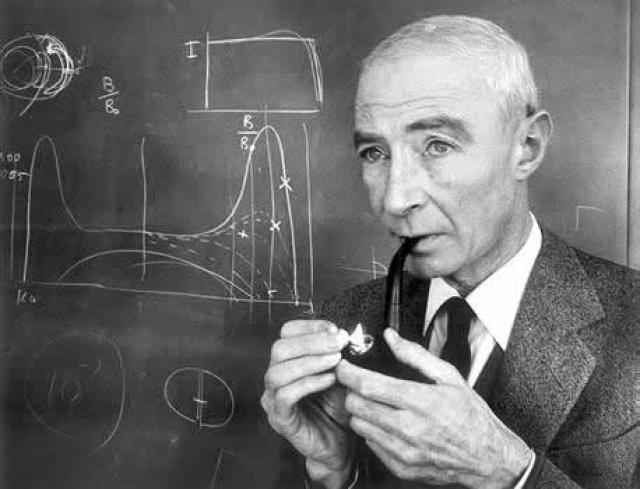
Julius Robert Oppenheimer, an American physicist, was born on April 22, 1904, in New York City. He graduated from Harvard University in 1925 and was accepted into Cambridge University the same year. He worked at the Cavendish Laboratory under the guidance of Rutherford. In 1926, he was invited by Max Born to the University of Göttingen, where he defended his doctoral dissertation in 1927. In 1928, he worked at the universities of Zurich and Leiden before returning to the United States.

From 1929 to 1947, Oppenheimer taught at the University of California and the California Institute of Technology. From 1939 to 1945, he actively participated in the Manhattan Project, leading the specially created Los Alamos Laboratory, which aimed to develop the atomic bomb. Over the next seven years, he served as a government advisor on atomic policy and from 1947 to 1952, he headed the General Advisory Committee of the U.S. Atomic Energy Commission.
From 1947 to 1966, Oppenheimer was the director of the Institute for Advanced Study in Princeton, New Jersey. In 1954, he was removed from all positions related to classified work and accused of disloyalty due to his opposition to the development of the hydrogen bomb and his advocacy for the peaceful use of atomic energy. The "Oppenheimer case" sparked significant controversy. In 1963, after nine years, he was awarded the Enrico Fermi Award by the U.S. Atomic Energy Commission, "in recognition of his outstanding contributions to theoretical physics, scientific and administrative leadership in the development of the atomic bomb, and active involvement in the application of atomic energy for peaceful purposes."
Oppenheimer is well-known not only for his role in creating the American atomic bomb but also for his numerous contributions to quantum mechanics, the theory of relativity, elementary particle physics, and theoretical astrophysics. In 1927, he developed a theory on the interaction of free electrons with atoms and, in collaboration with Born, created a theory on the structure of diatomic molecules. In 1931, he and P. Ehrenfest formulated a theorem that, when applied to the nitrogen nucleus, revealed contradictions with known properties of nitrogen, challenging the proton-electron hypothesis of nuclear structure. He also studied internal conversion of gamma rays, developed the cascade theory of cosmic rays in 1937, made the first calculations of neutron star models in 1938, and predicted the existence of black holes in 1939.
Oppenheimer authored several popular books including "Science and the Common Understanding" (1954), "The Open Mind" (1955), and "Some Reflections on Science and Culture" (1960). He passed away on February 18, 1967, in Princeton.