Kangxi
 China
ChinaBiography of Kansi
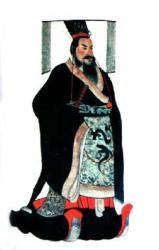
Kansi, the fourth emperor of the Qing dynasty in China, was born south of Beijing and ruled China for 61 years, which is an absolute record among all Chinese emperors and an impressive achievement on a global scale. Although he formally came to power at the age of 7, Kansi was effectively governed by four regents and his grandmother for a significant period of time. However, at the age of 13, Kansi took control of the country himself. He is considered one of the greatest emperors in China's history, known for his achievements such as suppressing the Revolt of the Three Feudatories, annexing the Taiwanese kingdom of Tungning, successfully preventing the expansion of Tsarist Russia, and expanding his empire to the northwest.
More importantly, under Kansi's rule, China finally experienced peace and prosperity after years of wars and chaos. His foundations lasted for several generations after his death. By the end of the Kansi era, the Qing Empire included all of China, Taiwan, Manchuria, parts of the Russian Far East, Inner and Outer Mongolia, Tibet, and Joseon Korea.
Kansi was born into the imperial family as the son of Emperor Shunzhi. At the age of 7, he officially ascended to the throne. According to some accounts, his father immediately retreated to a monastery, possibly influenced by the death of his favorite concubine or a persuasive Buddhist preacher. In any case, Empress Dowager disapproved of Shunzhi's decision and ordered all mentions of it to be erased from the chronicles, claiming that the emperor died of smallpox.
During the first six years of his reign, Kansi served merely as a figurehead emperor, with power in the hands of four regents and his grandmother. Eventually, Oboi became the sole regent, but in 1669, Kansi imprisoned him and took full control. His grandmother continued to assist him with valuable advice until her death in 1688. One of the early challenges Kansi faced was the Revolt of the Three Feudatories in 1673. The rebels attempted to gather forces in the southwest of the country, but Kansi's generals swiftly crushed the uprising while minimizing damage to innocent civilians' lands that became unintentional battlefields. It is known that Kansi himself planned to lead the armies into battle, but his advisors persuaded him otherwise. The revolt ended in 1681.
In 1683, the Kingdom of Tungning surrendered to the Qing fleet after the Battle of Penghu, led by Admiral Shi Lang. The ruler of Tungning had surrendered a few days earlier, making Taiwan effectively a territory of the Qing clan. Shortly after the victory, Kansi ordered the resettlement of the southern coast of China, offering financial support to all settlers.
In the 1650s, the Qing dynasty had several encounters with Russian troops, mostly in the Amur River region. The victories in the 1650s and a subsequent peaceful agreement in the 1680s solidified Qing's position.
Kansi's fame was not solely due to his military achievements; he also dedicated a significant amount of time to culture and education. One of his notable cultural and scientific projects was the Chinese character dictionary, known as the legendary "Kansi dictionary." Even in cultural aspects, Kansi managed to strengthen his own power by ensuring ideological corrections in various sources. He also showed interest in Western technologies brought to China by Jesuit missionaries such as Ferdinand Verbiest and Karel Slavicek.
Jesuits played an important role at Kansi's court, especially in the early years of his reign. Besides introducing new technologies, they assisted Kansi in resolving political issues. For example, the Treaty of Nerchinsk was signed with the help of Jean-François Gerbillon and Thomas Pereira. The emperor appreciated the unobtrusive behavior of the missionaries, who spoke Chinese fluently and wore appropriate silk attire. Problems arose only when Dominicans decided to intensify their fight against foreign idolatry and demanded Kansi to abandon traditional Chinese rituals. In response, Kansi officially banned Christian missions in China.