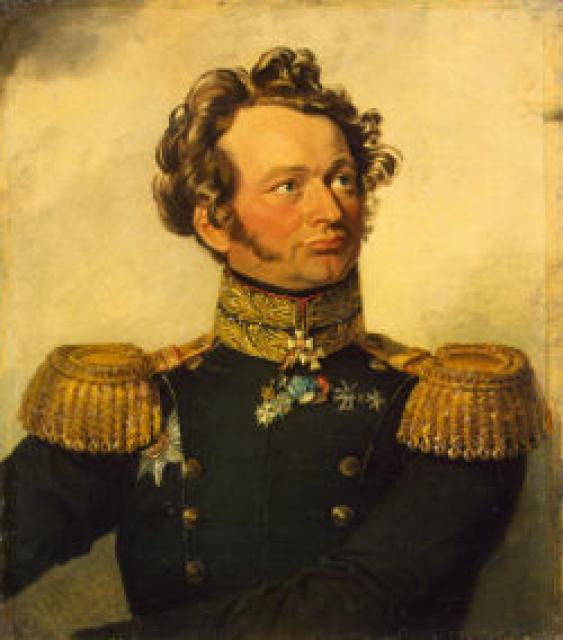
Karl Bistrom
 Russia
- Early Life and Military Service
- Distinguished Military Career
- Отечественной войны 1812 г.
- Later Campaigns
- Russo-Turkish War
- Polish Rebellion
- Final Years
Early Life and Military Service
Nikolai Andreyevich Bistrom(1774-1838) was a prominent Russian general and aide-de-camp. Hailing from a noble Baltic German family, he entered military service in 1784 with the Life Guards Izmailovsky Regiment. In 1787, he transferred to the Nevsky Musketeer Regiment and fought in the 1788-1790 Russo-Swedish War.
Distinguished Military Career
In 1798, Bistrom was promoted to major and appointed commander of the 1st Jaeger Regiment. In 1806, he assumed command of the 20th Jaeger Regiment. He distinguished himself as a brave and skilled combatant during the War of the Fourth Coalition (1806-1807). At the Battle of Czarnowo, he earned the Order of St. George 4th class for his valor.
Bistrom participated in several bloody battles during the war, including the Battle of Pułtusk and the Battle of Eylau. He received the "Pour le Mérite" from the Prussian king and a golden saber from Tsar Alexander I. Despite multiple wounds, he returned to the front and fought with distinction at the Battles of Heilsberg and Friedland.
Отечественной войны 1812 г.
In the Отечественной войны 1812 г., Bistrom played a crucial role in defending crossings over the Dnieper River. He also commanded an infantry brigade at the Battle of Borodino, where he faced the brunt of the enemy assault. His bravery earned him the Order of St. Anne 2nd class with diamonds.
Later Campaigns
In subsequent campaigns, Bistrom participated in the Battle of Leipzig and the capture of Paris. He commanded the 2nd Guards Infantry Division in 1821 and became a general-adjutant in 1825.
Russo-Turkish War
During the Russo-Turkish War of 1828-1829, Bistrom led a detachment against the Ottoman forces at Varna. He repulsed a fierce attack by Pasha Omer-Vrione and participated in the unsuccessful assault on the Turkish camp.
Polish Rebellion
In 1831, Bistrom returned to Poland to quell the outbreak of the November Uprising. He commanded the vanguard of the Russian army and successfully protected their retreat at the Battle of Ostrołęka. For his bravery, he received the Order of St. George 2nd class and was promoted to general of infantry.
Final Years
After the war, Bistrom assisted the commander of the Separate Guards Corps, Grand Duke Michael Pavlovich. He passed away in 1838 and was interred on his estate near Yamburg. Bistrom's military prowess and unwavering loyalty to the Russian Empire left an enduring legacy.


