Bela Miklosh
 Hungary
- Miklós von Dalnoky
- Military Attaché and Corps Commander
- World War II
- Defiance and Anti-Fascist Resistance
- Political Leadership
- Legacy
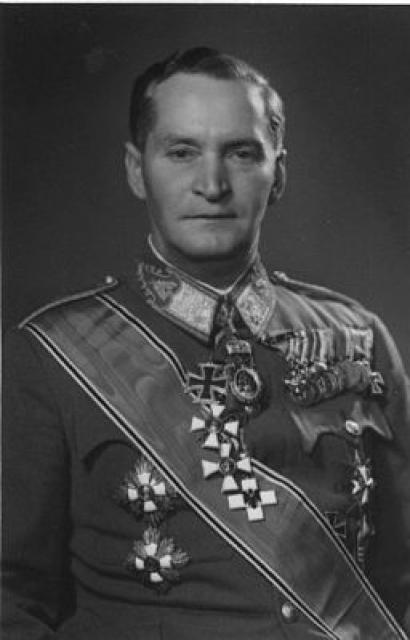
Miklós von Dalnoky
Early Life and Military CareerMiklós von Dalnoky was born in Budapest, Hungary, on April 20, 1890. He joined the Hungarian Army after the end of World War I, where he quickly rose through the ranks. From 1929 to 1932, he served as Deputy General Adjutant to Admiral Miklós Horthy and Deputy Head of the Military Office of the Regent.
Military Attaché and Corps Commander
In 1932, Dalnoky was appointed Head of Military Intelligence for the General Staff. He later became Military Attaché in Berlin from 1933 to 1936. In 1936, he assumed command of the 7th Infantry Regiment, and in 1938, he took over the 1st Cavalry Regiment and the 2nd Cavalry Brigade.
On October 1, 1940, Dalnoky was appointed commander of the newly formed Mobile Corps, the most elite unit in the Hungarian Army. He led the Corps to victory in Yugoslavia and gained immense popularity within the military.
World War II
In June 1941, Dalnoky's Corps formed the backbone of General Ferenc Szombathelyi's "Carpathian Group." Despite his corps' outdated tanks, Dalnoky achieved notable successes in the initial stages of the war. However, after heavy losses, the Corps was withdrawn to Hungary in November 1941.
In February 1942, Dalnoky commanded the IX Army Corps. He was subsequently appointed General Adjutant and Head of the Military Office of Horthy in August 1942. In August 1944, he was given command of the 1st Army (approximately 300,000 troops), which was deployed to the Soviet-German front.
Defiance and Anti-Fascist Resistance
After the takeover of power by Ferenc Szálasi, Dalnoky resigned his command on October 16, 1944, and joined the anti-fascist resistance. Approximately 10,000 troops followed him in defecting to the Soviet side, while the remnants of his army retreated to Hungary.
Political Leadership
On December 22, 1944, Dalnoky became the head of a coalition government in Hungary, which included representatives from the Communist Party, the Party of Smallholders, the National Peasant Party, and the Social Democrats. He resigned from his post on November 4, 1945, and was replaced by Zoltán Tildy.
Legacy
Miklós von Dalnoky died on November 11, 1948. He is remembered as a distinguished military commander who fought bravely during World War II. His defiance against the fascist regime solidified his position as a symbol of courage and principle in Hungary's history.