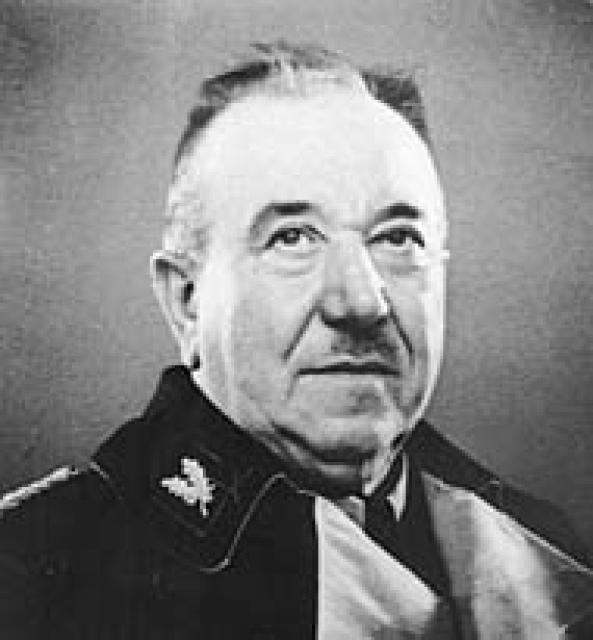
Karl Maria Wiligut
 Germany
- Biography of Karl Maria Wiligut
- Early Life and Military Service
- Association with Heinrich Himmler and the SS
- Archaeological Excavations and Religious Roles
- Later Life and Beliefs
Biography of Karl Maria Wiligut
Karl Maria Wiligut was a German neo-pagan, who had a significant influence on the mystical beliefs of the Third Reich. He was born in Vienna into a military family of the Austrian army. In 1884, he entered military service and in 1889, he was initiated into a Masonic lodge. Among his acquaintances were members of the Order of New Templars.
Early Life and Military Service
At the beginning of the 20th century, Wiligut started writing poems, drawing inspiration from local mythology and folklore. During World War I, he participated in combat on the Russian and Italian fronts. He was discharged from military service in 1919 with the rank of colonel. After the war, Wiligut began reconstructing the history and mythology of ancient Germanic tribes. However, during this time, he faced financial and family problems, which led him to be admitted to a mental institution, where he believed he was a victim of a Masonic conspiracy. From 1924 to 1927, Wiligut stayed in a psychiatric clinic in Salzburg, diagnosed with schizophrenia.
Association with Heinrich Himmler and the SS
In 1932, Wiligut emigrated to Germany where he met Reichsführer SS Heinrich Himmler. With Himmler's patronage, he assumed the position of the head of the Department for the Study of Early History, under the pseudonym Karl Maria Weisthor, which was specially created for him within the SS. In April 1934, he was appointed the rank of Standartenführer SS, in November 1934, he became an Oberführer, and in 1935, he was promoted to Brigadeführer, with an appointment in Berlin.
Archaeological Excavations and Religious Roles
In 1936, as part of the Ahnenerbe institute, Wiligut, together with Gunther Kirchhoff, began excavations on the Murg Hill in the Black Forest near Baden-Baden, where he claimed to have found ruins of the ancient Irminist settlement. Within the SS, Wiligut served as an Irminist priest, participating in marriage rituals at the Wewelsburg castle. He also designed the design for the Totenkopfring, a ring personally awarded by Himmler to distinguished officers. During this time, Weisthor was also assigned to analyze the works of Julius Evola. In 1938, Himmler's personal adjutant, Karl Wolff, located Wiligut's wife, Malvina, and obtained documents and medical certificates from her, which greatly disturbed Himmler. In 1939, Wolff informed Wiligut that he was dismissed from his position due to weak health and age.
Later Life and Beliefs
In 1940, Wiligut settled in Austria where he spent the rest of the war. After the war, he decided to return to Germany but passed away on his way. Many researchers note the similarity between Wiligut's main ideas and the ideology of Armanism. Wiligut claimed to be a descendant of the ancient Germanic holy dynasty of Wiligotis, who were born from the union of the celestial gods (Aesir) and the water gods (Vanir). He believed that this ancestry allowed him to retain the memory of events from a thousand-year history when three suns shone in the sky and the earth was inhabited by giants, gnomes, and other fantastic creatures. Wiligut claimed that his father dedicated him to the ancestral secret, and that his deceased relatives regularly gave him instructions and advice in runic form.
Wiligut introduced the term "Irminism," which he used to refer to the true Germanic religion, in contrast to "Odinism," which he considered a false religion. He claimed that the Bible was originally written by ancient Germans and dedicated to the ancient Germanic god named "Krist," who was crucified by the followers of Wotan in 9600 BCE. According to Wiligut, the text of the Bible was later falsified by Christians (who borrowed the name "Krist"), Masons, and Jews.


