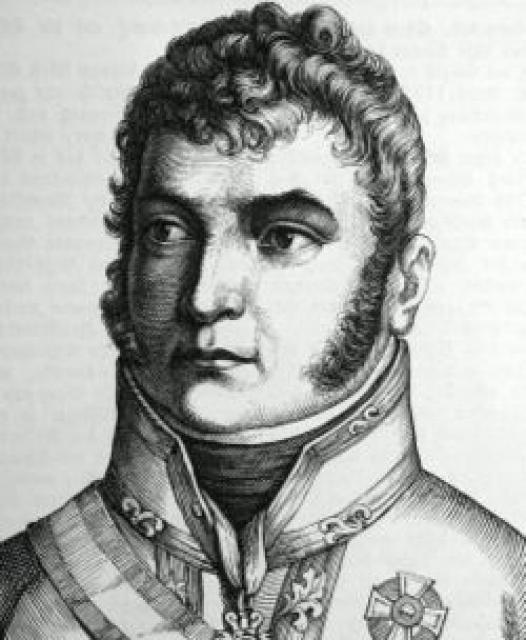
Karl Shvartsenberg
 Austria
- Karl Philipp zu Schwarzenberg
- Napoleonic Wars
- Senior Command
- Diplomatic Missions
- War of the Sixth Coalition
- Commander-in-Chief
- Battle of Leipzig
- Later Career
- Triumph and Retirement
Karl Philipp zu Schwarzenberg
Early Life and Military CareerPrince Karl Philipp zu Schwarzenberg was born into an ancient Franconian dynasty that had been elevated to the princely rank of the Holy Roman Empire on July 14, 1670. In 1787, he joined the Braunschweig-Wolfenbüttel Infantry Regiment (later the 10th Infantry Regiment) as a lieutenant. He distinguished himself in the Austro-Turkish War and was promoted to captain for his bravery in the storming of Šabac in 1788.
Schwarzenberg fought under the command of the renowned general Ernst Laudon and showed great valor in the battles of Berbir and Belgrade in 1789. In 1790, he served on the Lower Rhine and in the Netherlands, earning the rank of major.
Napoleonic Wars
In 1791, Schwarzenberg transferred to the Wallonian Latour Regiment (later the 14th Dragoon Regiment). For his actions in the battles of Jemappes and Neerwinden, he was promoted to lieutenant colonel in 1793. After the battle, he led part of Prince Sachsen-Coburg-Gotha's advance guard. That same year, he was assigned to the Uhlan Corps stationed in Galicia (later the 2nd Uhlan Regiment).
In 1794, Schwarzenberg became a colonel and commander of the Ceschwitz Cuirassier Regiment. On April 26, 1794, at Château-Cambrésis, he executed a renowned cavalry charge on the left flank of the enemy. The Austrian forces captured 3,000 prisoners and 32 canons that day. Schwarzenberg further distinguished himself at the Battle of Fleurus.
Senior Command
From 1795-96, Schwarzenberg fought in the Rhineland and Italy under the command of Dagobert von Wurmser and Archduke Charles. In 1796, he played a crucial role at Amberg and was promoted to major general for his victory at Würzburg on September 3, 1796. In 1797, he returned to the Rhineland, where he led the army's advance guard.
In 1799, Schwarzenberg commanded a division in Archduke Charles' army in Germany and Switzerland. He successfully resisted the French General Michel Ney at the Battle of Heidelberg and was promoted to lieutenant field marshal for his bravery in September 1800.
Diplomatic Missions
After 1800, Schwarzenberg served as colonel of the 2nd Uhlan Regiment, which was renamed the Schwarzenberg Uhlan Regiment. In 1805, he was appointed vice-president of the Hofkriegsrat, the Austrian War Council. After the Peace of Tilsit in 1807, he was sent to St. Petersburg as ambassador, tasked with securing Austrian support in a future war against France.
War of the Sixth Coalition
Schwarzenberg returned to the army two days before the Battle of Wagram. For his actions at Wagram, where he led part of the cavalry on the left wing and commanded the rearguard during the Austrian retreat, he was promoted to general of cavalry. After the Treaty of Vienna, he was appointed Austrian ambassador to Paris and negotiated Napoleon's marriage to Archduchess Marie Louise of Austria.
In 1812, during Napoleon's Russian campaign, Schwarzenberg commanded the Austrian auxiliary corps (approximately 30,000 men) within the Grande Armée. His troops crossed the Bug and halted near Pinsk. On August 12, he attacked parts of General Alexander Tormasov's 3rd Army at Gorodechno but limited himself primarily to artillery bombardment. Schwarzenberg avoided large-scale engagements with Russian forces in Russia.
Commander-in-Chief
On December 2, 1812, Napoleon secured the rank of field marshal for Schwarzenberg from Emperor Francis I. In September, Schwarzenberg's forces were pushed out of Russia by General Pavel Chichagov. After Napoleon's defeat in Russia, Schwarzenberg played a relatively inactive role but covered the retreat of General Jean Reynier's French corps.
As Austrian ambassador, Schwarzenberg arrived in France on April 17, 1813, where he attempted to mediate peace between Russia and France. After the mission failed, he left Paris and was appointed commander-in-chief of the forces in Bohemia. After Austria joined the anti-French coalition in August 1813, Schwarzenberg was named commander-in-chief of the allied Army of Bohemia, which comprised approximately 230,000 men, half Austrian and half Russian and Prussian.
Battle of Leipzig
In August 1813, Schwarzenberg's Army of Bohemia faced Napoleon at the Battle of Dresden, where it suffered a defeat and retreated to Bohemia, remaining there until early October. During the "Battle of the Nations" at Leipzig (October 16-19, 1813), the combined allied forces, largely consisting of Schwarzenberg's former army, defeated Napoleon decisively.
Later Career
In the campaign of 1814, Schwarzenberg faced criticism for being an overly cautious commander. After a failed attack on Nogent in February, he called for an armistice, claiming that agreements had been reached at the Châtillon negotiations (which was untrue). Following Napoleon's victory at Montreau, Schwarzenberg ordered a retreat to Troyes and directed Gebhard von Blücher to join him at Méry-sur-Seine.
On March 24, 1814, under pressure from Alexander I and Frederick William III, Schwarzenberg initiated a cautious advance on Bar-sur-Aube, driving back Claude Pelletier. After Napoleon's success at Reims, Schwarzenberg halted the advance and began a retreat to Troyes on March 17. He successfully fought at Arcis-sur-Aube and, despite initial setbacks, managed to position his army advantageously.
Triumph and Retirement
On March 25, the French were defeated at Fère-Champenoise, and on March 28, the allied armies united under the walls of Paris. On March 31, 1814, allied forces entered Paris, and Schwarzenberg resigned as commander-in-chief on May 5, 1814.
After Napoleon's return to France, Schwarzenberg was tasked with leading the allied forces on the Upper Rhine. His troops began crossing the Rhine but were delayed at Le Souffel by General Jean Rapp's small force. Napoleon's second abdication followed shortly thereafter. Upon his return to Austria, Schwarzenberg was appointed president of the Hofkriegsrat.
Schwarzenberg resigned in January 1817 after suffering a stroke. He passed away from a second stroke during a visit to Leipzig in October 1820.