Kashyapa
Kashyapa is one of the most widely remembered sages in Hindu tradition, but he is not a figure with a single, securely documented biography. Vedic and later Puranic texts associate the name with a seer, a patriarch of many divine and earthly beings, and a legendary ancestor of Kashmir. In the valley’s origin story, his intervention transforms a vast lake into habitable land.
A sage across many traditions
Kashyapa appears in several layers of Indian religious literature. In Vedic tradition he is counted among the revered seers, and in later texts he is described as a Prajapati, a progenitor who helps populate the cosmos. Puranic genealogies often make him the son of the sage Marichi and link him to a wide range of beings through marriages to daughters of Daksha. Depending on the text, those descendants include gods, demons, birds, serpents, and other creatures.
These accounts do not form one consistent family history. The name Kashyapa appears in different contexts and traditions, and later texts sometimes bring multiple legendary figures together. What remains constant is his role as a figure of ancestry and creation, associated with the ordering of life and the world.
The legend of Kashmir’s lake
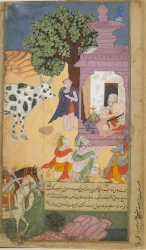
Kashyapa’s most prominent regional story is preserved in the Nilamata Purana and recalled by the twelfth-century Kashmiri chronicler Kalhana in the Rajatarangini. According to the legend, the valley was once a vast lake called Satisar, inhabited by the water demon Jalodbhava. The demon terrorized the nāga communities living around the lake, whose leader Nila appealed to Kashyapa for help.
Kashyapa sought the aid of the gods. In the story, Vishnu and other deities defeat Jalodbhava, and the lake is drained through an opening in the surrounding mountains. The newly exposed valley becomes Kashmir, a land where people can settle and worship. The tale connects the sage to sacred geography: rivers, lakes, mountains, and shrines become part of a meaningful landscape shaped by divine action.
Kalhana’s account is a historical chronicle that begins with origin traditions, while the Nilamata Purana is a religious text describing Kashmir’s sacred places and rituals. Their versions of the story reflect how communities explained the valley’s landscape and its spiritual identity. The traditional derivation of the name Kashmir from Kashyapa is influential, though the name’s etymology is not settled.
Legacy
Kashyapa’s story has endured because it links cosmic creation to a particular place. In broader Hindu tradition he is remembered as a seer and progenitor; in Kashmir, he is celebrated as the sage whose actions made the valley habitable. His biography belongs to sacred narrative rather than verifiable chronology, and the many versions of his life reflect the breadth of the traditions that preserved his name.