Kevessgaza Kevess
 Austria
- Early Life and Military Education
- Early Military Service
- Rise through the Ranks
- World War I
- Command of Army Group Kővess
- Success on the Eastern Front
- Balkan Campaign and Italian Front
- Brusilov Offensive and 7th Army Command
- Balkan Command and Collapse of Austro-Hungary
- Post-War Life
- Kővess died in Vienna on September 22, 1924.
Early Life and Military Education
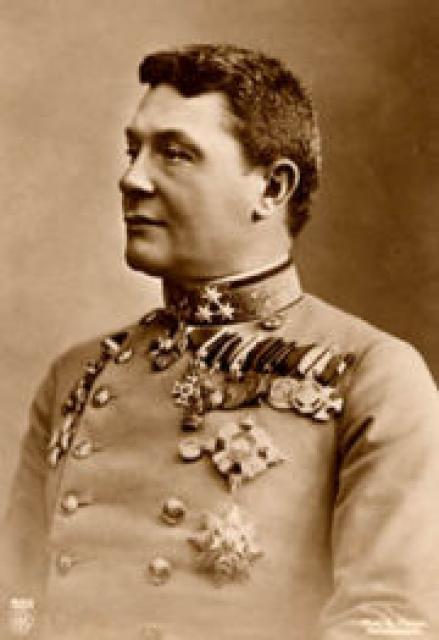
Baron Herman Kővess von Kővessházawas born on March 30, 1854, in Temesvár, Banat. He was the son of a general and later pursued a military career. He received his education at the Technical Military Academies of Klosterbruck and Vienna (1872) and the War Academy (1878).
Early Military Service
After graduating, Kővess was assigned to the 2nd Engineer Regiment in Vienna. He subsequently served in the headquarters of the 16th Infantry Division and the 12th Cavalry Brigade in Hermannstadt. In 1880, he transferred to the Sarajevo Military School.
Kővess participated in military operations in southern Dalmatia in 1882. He later served in the Operations Bureau and the headquarters of the 1st Army Corps (Krakow), and held field assignments in the 26th, 72nd, and 52nd Infantry Regiments.
Rise through the Ranks
In March 1898, Kővess took command of the 23rd Infantry Regiment, one of the finest units in the Austrian army stationed in Vienna. He became well-known in the capital and was one of the youngest colonels in the army. Notably, he remained a Protestant throughout his life, despite the tradition of Roman Catholics holding top positions in the military and government.
In October 1902, Kővess assumed command of the 15th Infantry Brigade (Innsbruck). In November 1906, he was appointed commander of the 8th Infantry Division (Bozen). In April 1910, he became inspector of the "Tyrol" command.
World War I
In June 1911, Kővess was promoted to commander of the XII Army Corps (Hermannstadt) and appointed commanding general in Transylvania. Shortly thereafter, he was also appointed a privy councilor. Concurrently, he became the chief of the 95th Infantry Regiment from August 1912.
During the 1912 maneuvers, Kővess achieved remarkable results and was considered one of the most promising generals in the Austro-Hungarian army. At the outbreak of World War I, he took the XII Army Corps to the front as part of the 2nd Army under General Eduard von Böhm-Ermolli.
Command of Army Group Kővess
During the Galician campaign of 1914, Kővess led Army Group Kővess, consisting of the III (General of Infantry Emil Köhlerus von Gelder) and XII Army Corps, as well as cavalry, infantry, landwehr, and honvéd divisions. The group was officially subordinate to the 2nd Army command, but the main part of the army and its command were deployed on the Balkan front. Kővess's group operated under the operational command of German General Richard von Woyrsch on the right flank of Austro-Hungarian forces.
Success on the Eastern Front
Kővess's group played a significant role in the Battle of Galicia, alongside the 3rd Army under General Rudolf Brudermann. On August 15 (28), the VII and XII Russian Army Corps attacked Kővess's group and defeated it at Podgajce. After the 2nd Army was deployed to the Russian front, Kővess's group became part of it.
Kővess later commanded Army Group Kővess from February 12, 1915. His forces took the Russian fortress of Ivangorod on July 22 (August 4), 1915. On September 27, 1915, he became commander of the 3rd Army, which included the XIX, VHI, and XXIII Army Corps, as well as the German Reserve Corps.
Balkan Campaign and Italian Front
Kővess led the 3rd Army during the Balkan campaign of 1915, which resulted in the occupation of Serbia, Montenegro, and Albania. He was awarded the German Pour le Mérite on November 29, 1915. After the defeat of Serbia, the 3rd Army was transferred to the Italian front in March 1916.
Kővess participated in the Trentino offensive in May 1916 and defeated Italian forces in Tyrol. However, the army was redeployed to the Eastern Front in July 1916 after the Russian offensive under General Aleksei Brusilov.
Brusilov Offensive and 7th Army Command
On the Eastern Front, Kővess led the 7th Army, which faced the Russian 9th Army and Romanian forces. He successfully defended the Bukovina Carpathians against Russian attacks. In July 1917, he launched a counteroffensive that pushed the demoralized Russian troops beyond the Prut River.
Balkan Command and Collapse of Austro-Hungary
In October 1918, Kővess was appointed commander of the Balkan forces. After the collapse of the Bulgarian armies and Bulgaria's capitulation, he was made supreme commander of all armed forces in the Balkans.
On November 3, 1918, Emperor Karl I appointed Kővess as Supreme Commander-in-Chief of all Austro-Hungarian armed forces, which were by then in complete disarray. An armistice was signed the same day, and hostilities on the Italian front ceased on November 4.
Post-War Life
After the war, Kővess lived in Vienna and Budapest. In May 1919, he was asked to lead the "white" Hungarian forces, but he declined, stating that he did not interfere in politics. He served as a member of the House of Magnates in the Hungarian Parliament.