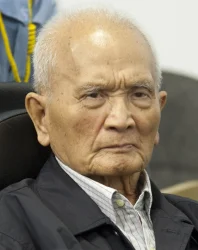
Khamtai Siphandone
Khamtai Siphandone was a Lao revolutionary commander who became one of the country’s longest-serving political leaders. He helped lead the Pathet Lao during the civil war and, after the communists took power in 1975, held senior military and government posts. As prime minister, party chairman and president, he presided over a period of economic change while maintaining the Lao People’s Revolutionary Party’s monopoly on political power.
From southern Laos to the revolutionary movement
Born on February 8, 1924, in what is now Champasak Province in southern Laos, Siphandone grew up in a rural family. He worked as a postmaster before joining the Lao Issara independence movement in the years after the Second World War. When the movement split, he aligned with the Pathet Lao, the communist-led force that fought the royal government during the Laotian Civil War.
He rose through the movement’s military and political ranks, serving as a commander in southern Laos and later becoming commander-in-chief of the Lao People’s Liberation Army. The Pathet Lao received substantial support from North Vietnam, and the conflict was intertwined with the wider wars in Indochina. When the Pathet Lao took Vientiane in 1975 and abolished the monarchy, Siphandone became deputy prime minister, defense minister and a central figure in the new Lao People’s Democratic Republic.
Party and state leadership
Siphandone became prime minister in 1991. After the death of party leader Kaysone Phomvihane in 1992, he took over as head of the Lao People’s Revolutionary Party. In 1998, he became president, holding both party and state authority until stepping down in 2006.
His years at the top coincided with Laos’s shift away from a centrally planned economy. The New Economic Mechanism, introduced before his premiership, expanded private enterprise, market pricing and foreign investment. His government continued the transition, seeking growth and closer regional ties while preserving state control over strategic sectors. The reforms helped change the economy, but they did not bring political pluralism.
The 1991 constitution gave the Lao People’s Revolutionary Party a leading role at every level of government and made it the only legal political party. Under Siphandone’s leadership, authorities continued to restrict opposition, independent media and public protest. In 1999, students who called for political freedoms and the release of prisoners were arrested after attempting to demonstrate in Vientiane. Amnesty International and other observers also reported the detention of political and religious prisoners during this period.
Later life and legacy
Siphandone retired from senior party and state offices in 2006, after decades in the leadership. He died in Vientiane on April 2, 2025, at the age of 101. His son Sonexay Siphandone later became prime minister, extending the family’s presence in Lao politics.
Supporters remember him as a commander in the struggle for independence and a leader who helped preserve stability while the country opened its economy. His legacy also reflects the political system he helped build: economic change proceeded under tightly controlled one-party rule, and challenges to that rule were not freely permitted. His career traces Laos’s path from anticolonial struggle and civil war to a state that embraced markets without embracing multiparty democracy.