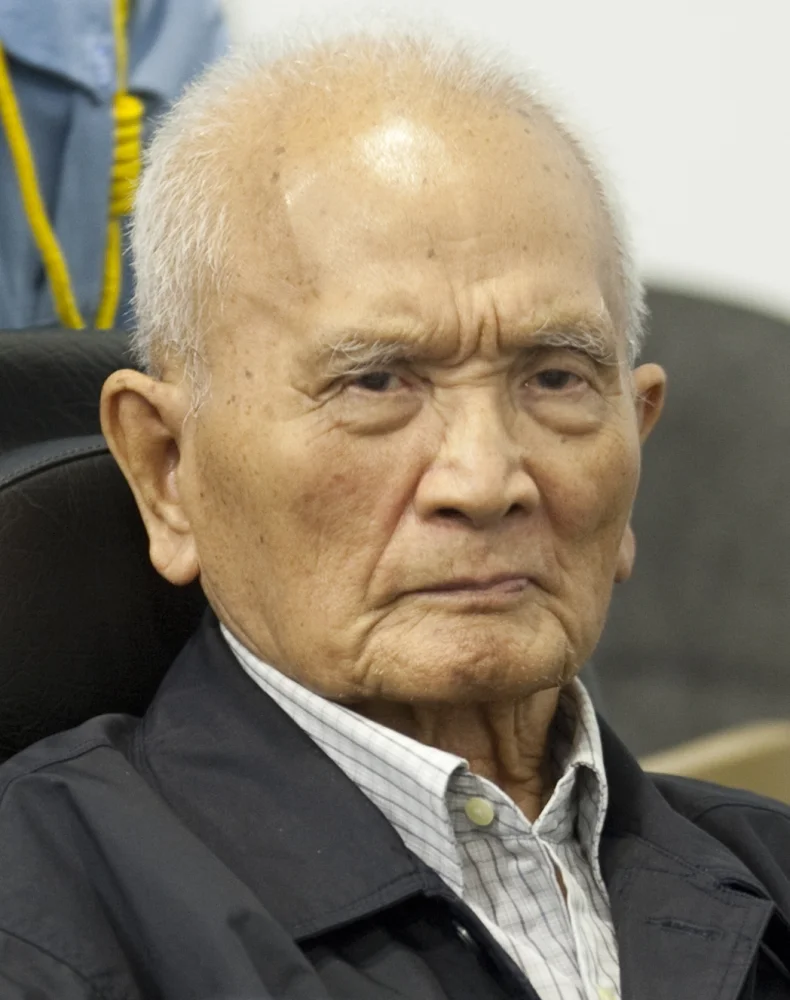
Nuon Chea
Nuon Chea was the Khmer Rouge’s chief ideologue and, after Pol Pot, its most powerful leader. Known as “Brother Number Two,” he helped shape the policies of Democratic Kampuchea, the regime that ruled Cambodia from 1975 to 1979. Its forced evacuations, mass executions, forced labor and starvation killed a large share of the population. Decades later, a UN-backed tribunal convicted him of crimes against humanity and sentenced him to life in prison.
From student to communist organizer
Born Lao Kim Lorn in Battambang on July 7, 1926, Nuon Chea grew up in a Sino-Khmer family. During the Second World War, Thailand annexed Battambang, and he moved to Bangkok. He studied briefly at Thammasat University, spent time as a Buddhist monk and joined the Communist Party of Thailand before returning to Cambodia in 1950.
He became active in the Cambodian communist movement, working with senior organizer Tou Samouth and the younger Saloth Sar, later known as Pol Pot. In 1960, he became deputy secretary of the Workers’ Party of Kampuchea, which later became the Communist Party of Kampuchea. As the movement grew, Nuon Chea helped develop its ideological line and trained cadres in the countryside. His influence rested on both his senior party position and his role in communicating revolutionary doctrine.
The Khmer Rouge in power
The Khmer Rouge captured Phnom Penh in April 1975. The new government emptied the cities, forced people into rural labor, abolished private property and sought to remake society through a radical agrarian revolution. Nuon Chea became deputy secretary of the ruling party and chaired the People’s Representative Assembly. He was also briefly acting prime minister.
The Extraordinary Chambers in the Courts of Cambodia found that Nuon Chea was a key decision-maker with authority over lower-level cadres. The court held him responsible for policies that drove population transfers, persecution and killings, and found that he helped formulate and disseminate those policies. The tribunal also found that he knew about crimes in cooperatives, worksites and security centers, and that he was involved in nationwide purges.
The regime’s campaign against perceived enemies reached across Cambodian society. Former officials, intellectuals, religious communities and people accused of disloyalty were imprisoned or killed. The court also addressed crimes against the Cham, a Muslim minority, and ethnic Vietnamese, as well as forced marriage and rape. Nuon Chea denied wrongdoing and argued that his government had acted to protect Cambodia from foreign domination.
Trial and legacy
Vietnamese forces overthrew the Khmer Rouge government in 1979. Nuon Chea and other leaders continued the insurgency from the Thai-Cambodian border area. In 1998 he left the movement and returned to Cambodian government control under an amnesty arrangement. He lived in Pailin until his arrest in 2007.
In 2014, the ECCC convicted him of crimes against humanity related to the forced evacuation of Phnom Penh and other population movements. That life sentence was upheld on appeal in 2016. In 2018, the court convicted him again of crimes against humanity and grave breaches of the Geneva Conventions, and found him guilty of genocide against Vietnamese and Cham communities. He died in Phnom Penh on August 4, 2019, while the later judgment was under appeal; those 2018 convictions therefore did not become final.
Nuon Chea’s record remains one of senior responsibility in a system that inflicted catastrophic violence on Cambodia. The trial established, through years of evidence and testimony, how party leaders shaped and directed policies whose consequences reached ordinary people in every part of the country.


