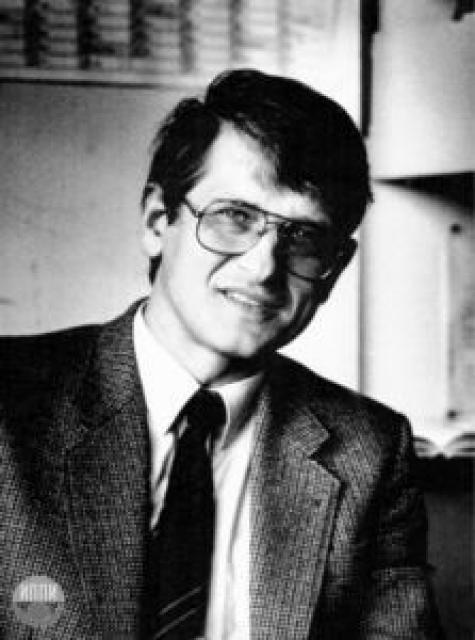
Klaus fon Klitcing
 Germany
- Biography of Klaus von Klitzing
- Discovery of the Quantum Hall Effect
- Significance of Klitzing's Discoveries
Biography of Klaus von Klitzing
Klaus Olaf von Klitzing is a German physicist and the recipient of the 1985 Nobel Prize in Physics. He was born during World War II in the city of Schröda, which was a part of Germany at the time (near the German-Polish border). He was the third of four children of forester Bogislav von Klitzing and Anna Ulbrich. When Klaus was born, it became clear that Germany's military situation was deteriorating and that parts of the Soviet Army would soon reach the vicinity of Posen (now Poznan), prompting the Klitzing family to flee westward. Shortly before the end of the war in April 1945, they settled in Lütten. In 1948, the family moved to Oldenburg, and then in 1951, to Essen.
Klaus received his secondary education at Artland Gymnasium in Quakenbrück, which allowed him to specialize in physics at the Technical University of Brunswick, where he enrolled in 1962. In Brunswick, Klaus first became acquainted with the problems of semiconductor physics. He also showed an interest in X-ray spectroscopy and even traveled to Darmstadt to take a programming course for computers, with the aim of using computer methods in spectroscopy. However, his attention was drawn to the measurement method of luminescence. He used it to determine the carrier lifetime in the semiconductor indium antimonide and presented his findings in his dissertation, supervised by F.R. Kessler, in 1969.
Afterward, Klaus moved to the University of Würzburg, where he taught laboratory techniques to medical students for some time. For the next ten years, he focused on researching semiconductors. In 1975, Klaus spent most of the year in Oxford, where the best superconducting magnets were being manufactured at the time. These magnets, which produced strong homogeneous magnetic fields, were an important tool for studying the behavior of electrons in semiconductors. In search of even stronger magnetic fields, Klaus left Würzburg in 1979 and went to work at the Laboratory for Strong Magnetic Fields in Grenoble. In 1980, he was appointed professor at the Technical University of Munich. He held this position until 1985, when he became the director of the Max Planck Institute for Solid State Physics in Stuttgart.
Discovery of the Quantum Hall Effect
The combination of low temperatures and strong magnetic fields that Klaus was able to study in Grenoble played a crucial role in his discoveries related to the Hall effect. The Hall effect, first observed in 1880 by American physicist Edwin H. Hall, had previously been considered only a rather imperfect means of measuring the electron concentration in semiconductors. In measurements based on this effect, an electric current is passed through a sample placed in a magnetic field applied perpendicularly. The sample develops a voltage perpendicular to both the current and the magnetic field. The magnitude of this Hall voltage is usually proportional to the magnetic field and inversely proportional to the electron concentration. However, the conclusions that can be drawn from these measurements typically have an error of about 10%, as there are many different interactions between electrons and lattice atoms in the semiconductor crystal.
In Grenoble, working in collaboration with Michael Pepper from the Cavendish Laboratory at the University of Cambridge and Gerhard Dorda from the research laboratories of Siemens in Munich, Klaus conducted an experiment that differed from traditional measurements primarily in the nature of the sample. The silicon that Klaus chose for the experiment was part of a transistor in which mobile electrons could only move in a very thin layer near one of the device's surfaces. Therefore, the electrons could only move in two dimensions, rather than three, as in a bulk sample. The behavior of such "two-dimensional" electrons under applied voltage significantly differed from the behavior of electrons in a bulk sample.
The most remarkable feature of Klaus's experiment was the deviation of the Hall voltage from the typically smooth behavior when the applied magnetic field and the electron concentration changed. When the number of electrons in the two-dimensional layer was increased smoothly, the Hall voltage initially decreased continuously, then remained constant for a while, then decreased again until the next horizontal step, and so on. By dividing the magnitude of the Hall voltage corresponding to each step by the current passing through the sample, the electrical resistance could be determined. Comparing the series of obtained resistances, Klaus noticed that they were all expressed as simple fractions of the same value: 25.183 ohms. This resistance could be represented as the ratio of two fundamental constants of nature - Planck's constant, which governs all quantum mechanical phenomena, and the square of the electron's electric charge. An important feature of the obtained result was the high precision with which this ratio could be measured. In repeated experiments, not only on samples of different shapes but also on transistors made from different materials, the value of the ratio could always be measured with an accuracy of about one ten-millionth. Such measurement stability allowed Klaus to immediately propose the hypothesis that the phenomenon now known as the Quantum Hall Effect could serve as the basis for an entirely new standard of electrical resistance. Klaus and his colleagues reported their discoveries in August 1980 in the journal "Physical Review Letters."
Significance of Klitzing's Discoveries
The work published by Klaus in 1980 is remarkable for at least three reasons. Firstly, it showed that quantum theory effects, which are most often observed in the behavior of microscopic quantities, such as individual electrons, can be observed in laboratory-scale measurements of electric current. Secondly, the discovered effect was completely unexpected for theoretical physicists who had been studying semiconductors for decades. Thirdly, the Quantum Hall Effect allowed for results that could be reproduced with such high precision that they immediately suggested a new international standard for the unit of electrical resistance - the ohm. Klaus was awarded the Nobel Prize in Physics in 1985 for the discovery of the Quantum Hall Effect. In the presentation speech by the Royal Swedish Academy of Sciences, it was noted that Klaus's work "opened up a new field of research, extraordinarily important not only for theory but also for applications... We are dealing here with a novel phenomenon in quantum physics, the characteristic features of which are only partially understood."
The precision and reproducibility with which the Quantum Hall Effect can be measured make it a phenomenon that extends far beyond metrology or the physics of semiconductor devices. Since the measured unit of resistance depends only on the most fundamental constants of nature, Klaus's result is also important for many other areas of physics. For example, the fine structure of emission spectra of hot gases is determined by the same combination of fundamental constants as the Quantum Hall Effect. Thus, the measured Hall resistance served as a test of the correctness of cumbersome theoretical calculations predicting the value of the fine structure constant in atomic spectroscopy. In some respects, Klaus's discovery of the Quantum Hall Effect can be compared to the phenomenon of superconducting tunneling predicted two decades earlier by Brian D. Josephson. Both effects allow for the observation of quantum mechanical behavior in laboratory experiments, which is usually limited to systems of atomic scale. Both effects led to the creation of new absolute standards for electrical quantities - the volt for Josephson and the ohm in the case of the Quantum Hall Effect. Klaus's work holds special significance as it stimulated the exploration of electrons effectively confined in two-dimensional spaces. Numerous new phenomena discovered in subsequent years and new problems arising in the physics of electronic layers owe their appearance in large part to the remarkable observations made by Klaus in 1980.
In 1971, Klaus married Renata Falkenberg, with whom he has two sons and a daughter. In addition to the Nobel Prize, he has been awarded the Walter Schottky Prize of the German Physical Society (1981) and the Hewlett-Packard Prize of the European Physical Society (1982).