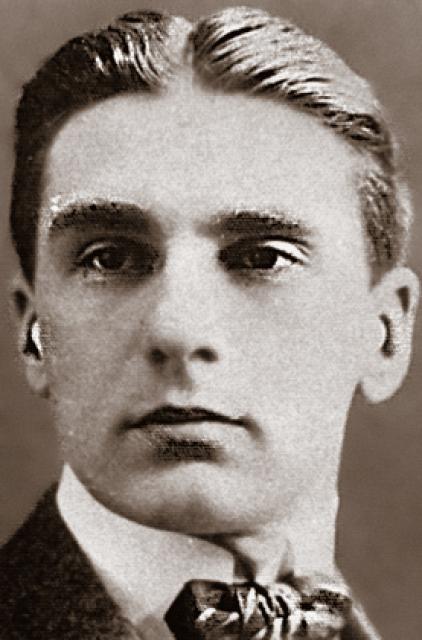
Konstantin Hohlov
- Early Life and Education
- Moscow Art Theatre
- Bolshoi Drama Theatre
- Leningrad Academic Theatre of Drama
- Maly Theatre
- Kyiv Russian Drama Theatre
- Return to Bolshoi Drama Theatre
- Cinematography and Teaching
- Recognition and Legacy
- Death and Legacy
Early Life and Education
Born in Moscow on October 20 (November 1), 1885, the renowned actor graduated from the Moscow Theatre School in 1908, where he studied under the renowned A.P. Lensky.
Moscow Art Theatre
Shortly after graduating, he joined the celebrated Moscow Art Theatre (MKhT) and its associated studios. Throughout his time at MKhT, he honed his acting skills and played unforgettable roles.
Bolshoi Drama Theatre
In 1921, he moved to St. Petersburg and joined the Bolshoi Drama Theatre. He promptly showcased his directorial prowess with a gripping production of Shakespeare's "Julius Caesar" (1922), in which he also played Mark Antony. He subsequently became the theatre's artistic director.
Leningrad Academic Theatre of Drama
From 1925 to 1930, he served as director of the Leningrad Academic Theatre of Drama, where he directed critically acclaimed productions, including Sophocles' "Oedipus Rex" (1924) and Trenev's "Pugachev Rebellion" (1926).
Maly Theatre
His directorial journey continued at the venerated Maly Theatre in Moscow from 1931 to 1938. Notable productions during his tenure included Gorky's "Enemies" (1933), Ostrovsky's "Wolves and Sheep" (1935), and Trenev's "On the Banks of the Neva" (1937).
Kyiv Russian Drama Theatre
One of his most fruitful artistic periods commenced in 1938 when he became the artistic director and chief director of the Kyiv Russian Drama Theatre. It was here that he created some of his most iconic productions, such as Lesya Ukrainka's "Stone Master" (1939, 1946), Gorky's "The Zykovs" (1940) and "Enemies" (1951), Soloviev's "Field Marshal Kutuzov" (1940), Leonov's "Invasion" (1944), Aleshin's "The Director" (1950), and Turgenev's "A Month in the Country" (1954).
Return to Bolshoi Drama Theatre
In 1954, he returned to the Leningrad Bolshoi Drama Theatre, where he directed Leonov's "Polovtsian Gardens" (1954) and Hauptmann's "Before Sunset" (1955).
Cinematography and Teaching
He ventured into cinematography in 1916 and appeared in several films. Alongside his acting career, he actively taught from 1922 onwards, becoming a professor in 1946.
Recognition and Legacy
His exceptional contributions to the world of theatre and cinema were acknowledged with the prestigious title of People's Artist of the USSR in 1944. He received the Order of Lenin and numerous other decorations.
Death and Legacy
The esteemed actor and director passed away on January 1, 1956, in Leningrad. His legacy continues to inspire generations of aspiring actors and directors alike.




