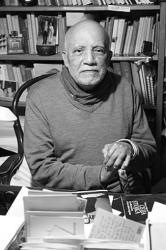
Kunio Ogawa
 Japan
Japan- Biography of Kunio Ogawa
- Early Life and Education
- European Journey and Literary Career
- Recognition and Later Life
Biography of Kunio Ogawa
Kunio Ogawa was a Japanese writer and representative of the literary "generation of introverts." He was known for his clear and refined style of storytelling, vivid imagery of Shizuoka, the Mediterranean, and the incorporation of Christian and agrarian motives into his works.
Early Life and Education
Ogawa was born in the city of Fujieda in Shizuoka Prefecture. During the war years, he, along with other students, participated in forced labor at the port, an experience that later influenced his artistic creations. In 1946, he enrolled in the philology department of Shizuoka University (under the pre-reform education system - an advanced level school). During the same period, he was baptized according to the Catholic rite and took the name Augustine. In 1950, he entered the University of Tokyo (Department of Japanese Literature) and made his debut as a writer in 1953 with the story "Eastern Coast," published in the magazine "Modern Literature."
European Journey and Literary Career
In October of the same year, Ogawa traveled to France, where he self-financed his studies at the University of Paris for the next three years. During his time in Europe, he traveled extensively, riding his Vespa scooter from country to country, visiting Spain, North Africa, Italy, Greece, and several other countries. In 1956, upon returning to Japan, he chose not to resume his studies at the university and began his life as a free artist. During this period, he created the doujinshi (self-published manga) called "Bronze Age." In 1957, he self-published the novel "Apollo's Island," written in an autobiographical manner based on his wanderings in Europe. However, it was not until eight years later that the book was purchased by writer Tosio Simao, who recognized Ogawa's literary talent and contributed to his recognition. With Simao's efforts, "Apollo's Island" was published in a business journal. The publication attracted attention and led to discussions about Ogawa as a representative of the "generation of introverts," a group of new writers that included Yoshikichi Furui, Senji Kuroi, Masei Goto, and several other talented authors.
Recognition and Later Life
Wide recognition and numerous accolades came to Ogawa in the 1980s and 1990s with the publication of stories such as "The Pensioner" (1986, Kawabata Prize), "Harbor of Sorrow" (1994, Ito Prize), and "Hashish Dealers" (1998, Yomiuri Prize). From 2005, he became a member of the Japanese Academy of Arts, and in 2006, he was awarded the Order of the Rising Sun. In his later years, he devoted much time and effort to teaching. He passed away from pneumonia at the municipal hospital in Shizuoka at the age of 80. Though closely aligned with the aesthetics of the "generation of introverts," Ogawa retained his individual characteristics. The main sources of his specific themes and images were the landscapes and people of his native Shizuoka, Mediterranean paintings, and biblical motifs. Ogawa was also influenced by his in-depth knowledge of Noh theater traditions and the works of Faulkner. His writing style is characterized by transparency, simplicity, concise imagery, and the conviction that full expression is possible with minimal means. Like many introverted writers, he gravitated towards the short form.