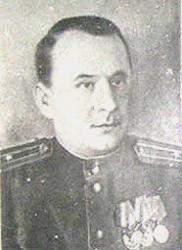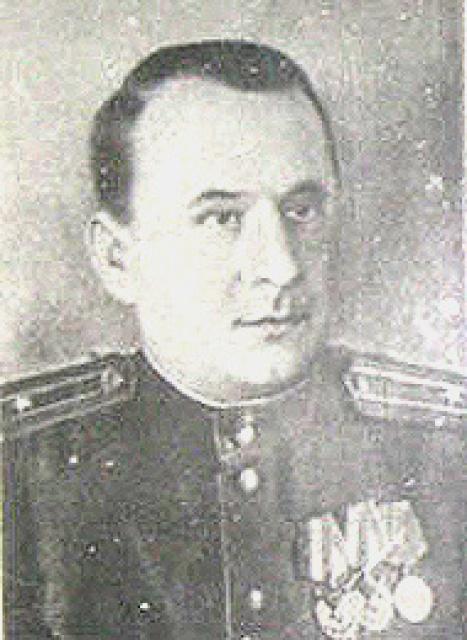
Kuzma Gnidash
Kuzma Gnidash was a Red Army officer whose wartime career moved from tank units to clandestine intelligence and partisan operations. Known behind enemy lines by the codename Kim, he led a reconnaissance and sabotage group through occupied parts of Ukraine and Belarus. His missions supported Soviet front headquarters, while his unit built connections with local resistance networks.
Early Life and Military Training
Gnidash was born in 1914 in Salohubivka, a village in what is now Ukraine’s Sumy region, to a farming family. He trained at an automotive and tractor school in Pryluky, graduating in 1933, and worked as a tractor driver and mechanic at a local machine and tractor station.
He entered the Red Army in 1936. Gnidash took part in the Soviet-Finnish War and, after completing political training and the Kyiv Military Tank School, served as an officer in the armored forces. When Germany invaded the Soviet Union in 1941, he fought on the Southwestern Front. He was wounded several times before his career shifted toward intelligence work.
Behind Enemy Lines
In 1942, after special reconnaissance and sabotage training, Gnidash was appointed commander of an operational group and parachuted into occupied territory near the boundary between Kyiv and Chernihiv regions. His codename, Kim, came from a childhood nickname his mother had used for him.
The group combined intelligence gathering with sabotage and cooperation with local residents. Under Gnidash’s command, several partisan detachments and underground groups took shape in the region. Their work included monitoring German troop and rail movements, passing information to Soviet commanders, and disrupting transport and military infrastructure. Local historical accounts credit the wider network with attacks on railway trains, bridges, vehicles, and river vessels, though the totals reported in wartime sources varied.
In September 1943, Gnidash’s group reached Soviet forces and came under the Central Front’s command. That December, it was sent back through occupied territory into Belarusian Polesie. The team covered a long route to reach the area and operated around Slutsk, Baranovichi, Kobrin, Osipovichi, and Brest. Reconnaissance reports on German positions and movements contributed to Soviet planning for the 1944 Belarusian offensive.
Final Mission and Death
In June 1944, Gnidash and a small group were based with partisans near Slonim in western Belarus. German forces surrounded the forest where they were operating. A partisan commander urged the group to break out in another direction, but Gnidash’s team had orders to continue toward a different objective.
As they attempted to cross the encirclement, the group encountered German troops searching the woods. Gnidash was wounded in both legs. To give the rest of his team a chance to get away and complete their assignment, he and radio operator Klara Davidyuk hid in a prepared dugout. They were discovered and died there on June 19, 1944, rather than be taken prisoner.
Recognition and Legacy
On March 24, 1945, Gnidash was posthumously awarded the title Hero of the Soviet Union. His decorations also included the Order of Lenin, two Orders of the Red Banner, and the Partisan of the Patriotic War medal, First Class.
Memorials to Gnidash were established in his home village and in Slonim, where he died. His story is also remembered through accounts of the intelligence group he led: a small force that relied on local support, careful observation, and radio contact to remain effective deep inside occupied territory.