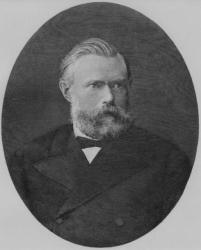
Larry Bell
 USA
USA- Early Life and Aviation Passion
- The Tragedy and a Broken Promise
- Founding Bell Aircraft Corporation
- Collaboration with Germany and World War II
- Post-War Innovations
- Space Exploration and the X-2
- Awards and Recognition
- Legacy
Early Life and Aviation Passion
Lawrence Dale "Larry" Bell was born on April 5, 1894, in Mentone, Indiana. At an early age, his family moved to Santa Monica, California. Bell's fascination with aviation began as a teenager when he attended an air show. In 1912, he began working as a mechanic alongside his brother Grover and test pilot Lincoln Beachey.
The Tragedy and a Broken Promise
Tragedy struck when Grover Bell died in an airplane crash. Lawrence vowed to give up aviation, but after being persuaded by a friend, he returned to the industry and joined the Glenn L. Martin Company. By the age of 20, he became shop foreman and later general manager, aiming to become a partner.
Founding Bell Aircraft Corporation
In 1929, Bell left Glenn L. Martin Company and joined Consolidated Aircraft in Buffalo, New York. He eventually became vice president and general manager. When Consolidated Aircraft relocated to San Diego, Bell, eager to lead his own company, remained in Buffalo and founded Bell Aircraft with 56 employees on July 10, 1935.
Collaboration with Germany and World War II
During a government-organized "spy tour" of Germany in 1938, Bell saw the Focke-Wulf Fw 61 twin-rotor helicopter. He utilized the German aircraft maker's aerodynamic design to mass-produce models for specific military requirements. During World War II, Bell Aircraft manufactured the Bell P-39 Airacobra and Bell P-63 Kingcobra fighter planes.
Post-War Innovations
After the war, the company produced the Bell X-1, designed specifically to explore the challenges of supersonic flight. On October 14, 1947, the X-1 became the first aircraft to break the sound barrier. Bell Aircraft also began developing helicopters in 1941, with the experimental Bell 30 taking flight in 1943.
Space Exploration and the X-2
In the 1950s, Bell Aircraft assisted the U.S. Air Force and NASA in pushing the boundaries of aircraft design and venturing into space exploration. The company's X-2 Starbuster rocket plane achieved Mach 3 speeds and altitudes of 126,000 feet in 1955, inspiring further development of spacecraft.
Awards and Recognition
Bell received the Daniel Guggenheim Medal from the Society of Automotive Engineers in 1944. He was posthumously inducted into the National Aviation Hall of Fame in 1977, the Army Aviation Hall of Fame in 1986, and the International Aerospace Hall of Fame in 2004.
Legacy
Lawrence Dale Bell died of a heart attack in Buffalo on October 20, 1956. Bell Aircraft faced financial difficulties in the years following his death. In 1960, the corporation was acquired by Textron and is now known as Bell Helicopter Textron.
Bell's hometown of Mentone, Indiana, honors his memory through the Bell Memorial Public Library and the Lawrence D. Bell Aviation Museum. The University of Buffalo's engineering complex is named Lawrence D. Bell Hall. The Helicopter Association International has awarded the Lawrence D. Bell Award for卓越 Management in Helicopter Operations since 1971.