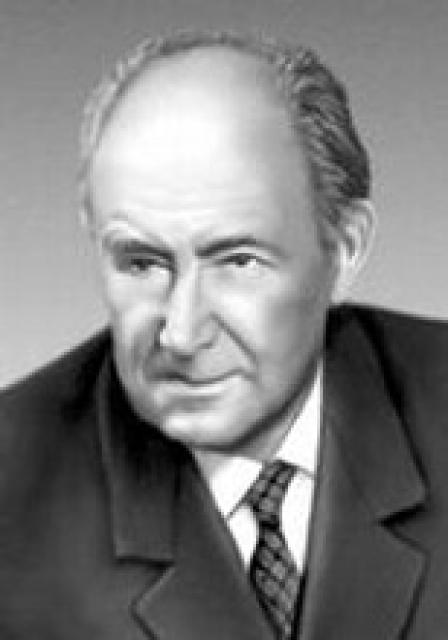
Leonid Rahlenko
- Early Life and Education
- Theater Career
- Among his notable theater roles were:
- Directorial Work
- "The Nightingale" by Yanka Bryl (1937)
- "Sea Hawk" (1941)
Early Life and Education
Born on August 24 (September 6), 1907, in the village of Terekhovka (present-day Gomel Region, Belarus), the actor began his artistic journey in 1924 when he enrolled at the Leningrad Institute of Scenic Arts, graduating in 1928. He studied under renowned mentors L. S. Vivien and S. E. Radlov.
Theater Career
In 1927, he joined the Leningrad Worker's Theater of Proletkult. From 1929, he took on acting roles, becoming a director in 1935. From 1937 to 1943, he served as the artistic director of the Belarusian Yanka Kupala Theater in Minsk.
Among his notable theater roles were:
Gorlokhovatsky ("Who Laughs Last" by Kondrat Krapiva)Makar Dubrava ("Makar Dubrava" by Alexander Korneichuk)
Gvozdilin ("The Third Pathétique" by Nikolai Pogodin)
Stepan Syrovarov ("Snowstorm" by Leonid Leonov)
Bubnov ("The Lower Depths" by Maxim Gorky)
Krutitsky, Flor Fedulovich ("Not All That Wise Men Are Simple," "The Last Sacrifice" by Alexander Ostrovsky)
Directorial Work
As a director, he brought to life the following acclaimed productions:
"The Nightingale" by Yanka Bryl (1937)
"Partisans" by Kondrat Krapiva (1938)"Guilty Without Fault" by Alexander Ostrovsky (1938)
"The Front" by Alexander Korneichuk (1942)
"The Bridge of Fire" by Boris Romashkov (1954)
"The Kremlin Chimes" by Nikolai Pogodin (1956)
Film Career
In addition to his theater work, the actor also appeared in several films, including:
"Sea Hawk" (1941)
"Mikolka-Parovoz" (1956)"Stepan Kolchugin" (1957)
"In the Days of October" (1958)
"The Clock Stopped at Midnight" (1958) - as Gotberg
"Spring Storms" (1960) - as a professor
"Schedule for the Day After Tomorrow" (1978) - as Professor Kalmykov
Later Life and Legacy
The actor passed away in Minsk in 1986. Throughout his illustrious career, he was bestowed with numerous accolades, including the title of People's Artist of the USSR (1966) and the State Prize of the Byelorussian SSR (1970). His contributions to theater and film continue to be celebrated and remembered today.