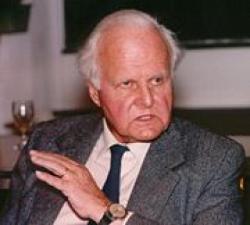
Leopold Infeld
 Poland
- Leopold Infeld: A Pioneering Theoretical Physicist
- Collaboration with Einstein and Cambridge
- Return to Poland and International Recognition
- Theoretical Contributions
- - Nonlinear electrodynamics (with M. Born)
- Literary Pursuits
- Legacy and Impact
Leopold Infeld: A Pioneering Theoretical Physicist
Early Life and EducationBorn into a Jewish merchant family in Poland, Leopold Infeld graduated from Jagiellonian University in Krakow in 1921. His academic pursuits led him to become an assistant in theoretical physics at the University of Lviv in 1930.
Collaboration with Einstein and Cambridge
In the early 1930s, Infeld embarked on a period of collaboration with renowned physicists. From 1933 to 1935, he worked in Cambridge, and from 1936 to 1938, he joined Albert Einstein at Princeton University.
Return to Poland and International Recognition
After serving as a professor at the University of Toronto from 1939, Infeld returned to Poland in 1950 and became a professor at Warsaw University. In 1962, he organized an influential international conference on gravitation.
Theoretical Contributions
Infeld's significant contributions to theoretical physics include:- Interpretation of the uncertainty principle
- Wave equation of the electron in general relativity (with B. L. van der Waerden)
- Nonlinear electrodynamics (with M. Born)
Collaboration on General RelativityTogether with Einstein and B. Hoffmann, Infeld derived equations of motion for a system of bodies in a gravitational field using general relativity. This work represented an advancement beyond Newtonian approximation.
Literary Pursuits
Beyond his scientific achievements, Infeld also authored several novels, including a biography of mathematician Évariste Galois (1948). His literary legacy is recognized through the Leopold Infeld Prize for scientific writing.
Legacy and Impact
Infeld's belief that "nothing in the world should remain forever hidden from the human mind" encapsulates his enduring impact on the field of physics. His contributions and collaborative spirit continue to inspire generations of scientists.