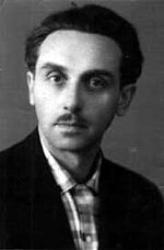
Lev Schultz
 France
Biography of Lev Schultz
Early Life and EducationLev Schultz was a Russian and French artist, jeweler, inventor, philosopher, and publicist. He was born on November 6th, 1897, in Rostov-on-Don, during a trip taken by his parents. Lev had a twin brother named Alexander. His father, Alexander Ivanovich Schultz, was a jeweler, amateur zoologist, hunter, and birdcatcher. His mother, Ekaterina Dmitrievna, was the daughter of D.A. Lachinov. Lev's maternal uncle, M.M. Schultz, was a physical chemist. He also had a brother named Georgy, who was a sculptor.
Early Career and Travels
In 1913, Lev studied at the Naval Cadet Corps, while his brother Alexander studied in the same institution. In 1914, Alexander passed away from typhoid during an epidemic. Lev lived in Europe with his mother, brothers, and sister Ekaterina in 1905 and 1906, where he traveled to France, Germany, and Switzerland. In Switzerland, he started studying at a college and received private lessons in visual arts.
In 1915, Lev graduated from the Tsarskoye Selo Real School of Emperor Nicholas II. In the same year, he enrolled in the architectural department of the Academy of Fine Arts. However, he was called to serve in the army and entered the Vladimir Military School for accelerated officer courses. He was released from the military academy in February of the following year for unknown reasons.
During his time in the army, Lev was injured in the jaw during the July events at the Putilov Plant in 1917. In 1918, he resumed his studies at the Academy of Fine Arts during a three-month leave. In the summer, he fled to Ukraine to join his father. In Berdichev, Lev taught drawing at an art studio for about a year. It was in Ukraine that he met Fyodor Rozhankovsky. Lev also witnessed the events in Kiev and wrote about the columns adorned with gallows, where they had to rely on their father's courage and composure to survive.
In 1919, Lev moved to Crimea, where his mother and uncle, Nikolai Dmitrievich Lachinov, were located. Nikolai served in the White Army's commissariat department. During this journey, Lev was almost shot by both the Red and White forces, but eventually, he became a cartographer in Pyotr Wrangel's headquarters. On November 26th, 1920, he arrived in Dubrovnik, Croatia, on one of the last steamers, the coal carrier Szeged, after a stopover in Constantinople.
Parisian Period
From 1920 to 1922, Lev studied art history at the Faculty of Philosophy at the University of Ljubljana in Yugoslavia. He also worked as a set designer at the Drama Theater in Novi Sad. In 1922, he moved to Vienna and worked in animation before traveling to Prague and Berlin and settling in Paris.
In Paris, from 1922 to 1923, Lev attended the Grand Chomier and Julian academies. He established close relationships with Serge Férat (Sergey Nikolayevich Yastrebov) and his cousin Baroness Hélène d'Ettingen. Serge, also known as "Apostrophe," was a surrealist artist and set designer who had staged the first surrealist play, "Les Mamelles de Tirésias," based on Guillaume Apollinaire's antimonial play. Lev and Hélène d'Ettingen became regular visitors to the baroness's salon, where they interacted with other artists, writers, and intellectuals.
In 1925, Lev illustrated the collection of poems "Ceramics" by Dmitry Kobyakov, and his work was reviewed by Vladimir Nabokov in the magazine "Rul." Lev also maintained a lifelong friendship with Fyodor Rozhankovsky, who he had known since their time in Russia.
During this period, Lev worked in various artistic and design fields, including jewelry design, haute couture, and theater set design. He also began developing his theories on cosmology and consciousness, which he expressed in his unpublished work "Essai sur la conscience universelle" (Essay on Universal Consciousness).
Later Years
In 1931, Lev embarked on a walking journey of 900 kilometers from Algeria to Tlemcen along the coast and from Algeria to Constantine through the Kabylie region in North Africa. He returned to Paris and participated in the decoration of pavilions for the World Exhibition. Lev also designed cabarets in Montmartre and created jewelry for the haute couture industry.
Lev continued his artistic pursuits and exploration of various disciplines throughout his life. His work included illustrations, design, invention, and literature, often aimed at educating and engaging children. In 1934, he published the book "L'Univers des Enfants" (The Universe of Children), which combined education and entertainment in a visually captivating format.
Lev Schultz's later years were marked by his travels and residences in Morocco, France, and Yugoslavia. Unfortunately, little information is available about his artistic activities during this period. However, his passion for various forms of art, his innovative approach, and his commitment to exploring the mysteries of the universe remained constant throughout his life.
Lev Schultz passed away in 1970, leaving behind a legacy of artistic accomplishments and a unique perspective on art, philosophy, and the mysteries of the universe.