Lewis Pugh
 Great Britain
- Biography of Lewis Pew
- Discovering a Love for Swimming
- Conquering Unusual and Dangerous Locations
- Challenging Cold Waters
- Bringing Attention to Climate Change
- Legacy and Message
Biography of Lewis Pew
Early Life and EducationLewis Pew, a British swimmer and athlete, was born in England into a prosperous family. From an early age, he had a passion for learning and excelled both academically and athletically. He set his sights on becoming a lawyer while still in secondary school. However, it was during his time at university in London that he discovered his father's hidden passion for travel, which was evident in the numerous geographical maps and National Geographic subscriptions scattered around their home. This realization sparked a new interest in Lewis, leading him to explore his own path in life.
Discovering a Love for Swimming
During his time in London, Lewis frequently swam in open water and realized that he could potentially pursue a lifelong career in the sport. Inspired by his friend David Becker's words, "Follow your own dreams, Lewis, or you will spend your life chasing someone else's," Lewis decided to challenge himself and prove that the limits of the human body and will are almost boundless. At the age of 22, he completed a 14-hour and 50-minute swim across the English Channel, opening his eyes to the vast possibilities of swimming beyond world records and the Olympics.

Conquering Unusual and Dangerous Locations
Lewis made it his mission to swim in the most unusual and dangerous locations on the planet. In September 1990, he became the first person to swim around the Cape of Good Hope in South Africa, battling enormous waves crashing against the rocky shores in just one and a half hours. A few months later, he broke his own record by swimming the English Channel once again. In 1992, Lewis swam across the Great African Lake, inhabited by numerous hippos and crocodiles, covering a distance of 25 kilometers in 9 hours and 52 minutes. This daring feat earned him the reputation of being "crazy" since no other swimmer would dare enter waters infested with crocodiles.
Challenging Cold Waters
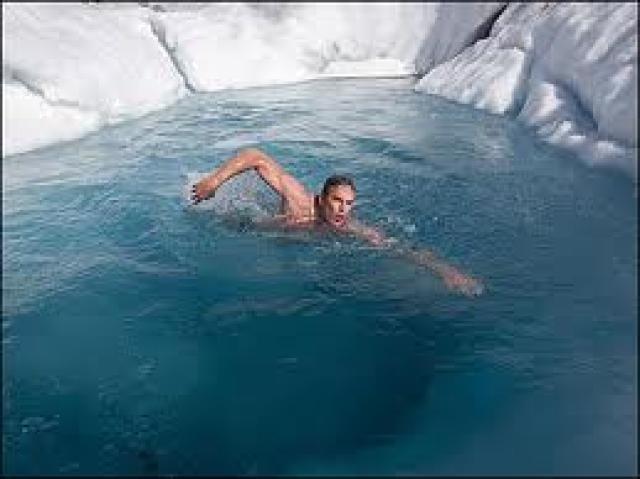
Lewis then turned his attention to swimming in the coldest waters on the planet. His first achievement in the Arctic Circle was swimming around Nordkapplatået in the Barents Sea. With water temperatures just above 8 degrees Celsius, he completed the swim in 1 hour and 4 minutes, coming close to hypothermia. This became the longest swim in the northern Arctic Circle, and a documentary film titled "Swimming Norway" was later released by National Geographic. In August 2004, Lewis swam 204 kilometers along the Sognefjord in Norway, enduring a temperature of approximately 10 degrees Celsius for 74 hours and 47 minutes. A few months later, he set another record by swimming 1 kilometer in 18 minutes and 10 seconds, with the water temperature at 0 degrees Celsius. Despite the extreme conditions, Lewis persisted and completed a mile swim in 30 minutes, setting a new record for the longest duration in polar waters.
Bringing Attention to Climate Change
In 2007, Lewis aimed to draw attention to the issue of global warming by swimming 1 kilometer at the North Pole. The swim lasted 18 minutes and 50 seconds and set a record for the coldest water temperature he had ever experienced. Lewis emphasized the significant changes in the region due to melting ice, making the swim possible. He admitted that this was the most challenging swim of his life and vowed to stay away from open water. However, in 2010, he embarked on a new adventure by swimming in Imja Lake located on one of the southern glaciers of Mount Everest, at an altitude of 5,300 meters. Overcoming the lack of oxygen, Lewis completed the swim of 1 kilometer in 22 minutes and 51 seconds on his second attempt.
Legacy and Message
Lewis Pew's swimming accomplishments have not only broken records but have also brought attention to the urgent ecological issues facing the planet. Through his various swims, he encourages individuals to rethink their lifestyles and take action towards a more sustainable future. Lewis's journey serves as an inspiration for everyone to strive towards their own goals, even if it means taking a different path.