Lidiya Zvyagina
- Early Life and Education
- Vocal Training and Breakthrough
- OPERATIC Career
- Reputable Roles and Accomplishments
- Versatility and Premieres
- Notable Collaborations
- Pedagogical Contributions
- Legacy and Recognition
Early Life and Education
Born in Kyiv, Ukraine, Lydia Zvyagina pursued higher education at Kyiv's Women's Courses. Her musical journey began at the Kyiv Music School, where she studied singing. From 1882 to 1887, she refined her abilities at the St. Petersburg Conservatory under the tutelage of Anna Polyakova-Khvostova, Elizaveta Tsvanziger, and Camillo Everardi.
Vocal Training and Breakthrough
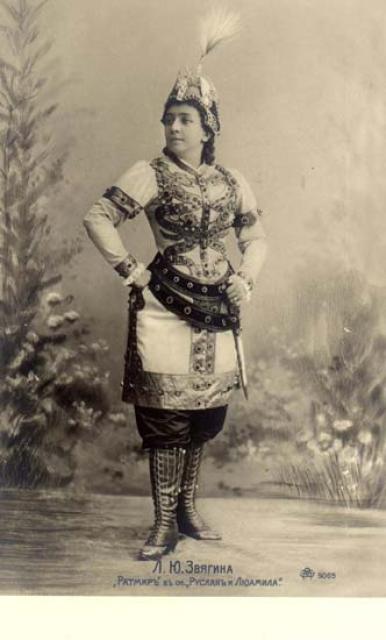
During the summers of 1890 and 1891, Zvyagina traveled to Paris for advanced training with renowned mezzosoprano Pauline Viardot. Under Viardot's guidance, she honed her vocals and prepared for significant roles such as Ratmir in Glinka's "Ruslan and Lyudmila," the Princess in Dargomyzhsky's "Rusalka," and Carmen.
OPERATIC Career
In 1887, Zvyagina joined the Tiflis Opera, where she further developed her repertoire under the direction of Ippolit Pryanishnikov. In 1889, she became a permanent member of the Moscow Imperial Opera. For two decades, from 1889 to 1909, she graced the stage of the Bolshoi Theatre as a celebrated soloist. Her debut as Ratmir marked the beginning of her illustrious tenure.
Reputable Roles and Accomplishments
Zvyagina's vocal prowess and meticulous phrasing earned her acclaim in a diverse range of operatic roles. Notable among them were Ratmir, Vania ("A Life for the Tsar"), Polina ("The Queen of Spades"), Konchakovna ("Prince Igor"), and the Princess ("Rusalka"). She premiered the roles of the Slave in Korechenko's "Belshazzar's Feast" and Marfa in Blamberg's "The Tusshiners."
Versatility and Premieres
Beyond her operatic repertoire, Zvyagina also showcased her versatility in concerts with the Circle of Lovers of Russian Music. She performed romances by Glinka, Dargomyzhsky, Borodin, Mussorgsky, Rimsky-Korsakov, Cui, Rachmaninoff, and Arensky. In the Bolshoi Theatre, she was the first to perform the roles of Marta ("Iolanta"), Lel ("The Snow Maiden"), Solokha ("Christmas Eve"), Checca ("La Gioconda"), and Schwertleite ("Die Walküre").
Notable Collaborations
Zvyagina shared the stage with renowned singers such as Lev Klements, Bogomir Korsov, Mikhail Medvedev, Leonid Sobinov, Fyodor Chaliapin, and Margarita Eichenwald. She performed under the baton of conductors Ulrich Avranek, Ippolit Altani, and N. Fyodorov.
Pedagogical Contributions
From 1920 to 1924, Zvyagina imparted her knowledge as a professor at the Moscow Conservatory. Among her students was future People's Artist of the USSR, Nikandr Khanayev. She also taught at the former Valentina Zograf-Plaksin's Moscow Private Music School, which later became the Sixth Moscow State Music School.
Legacy and Recognition
Lydia Zvyagina's impressive vocal range and natural musicality captivated audiences throughout her career. Her artistry was characterized by expressive phrasing and a profound understanding of her roles. Her portrayals of iconic operatic figures remain etched in the annals of operatic history.