
Liz Barton
 Great Britain
- The British Woman with Neurofibromatosis Type 1 and Kyphoscoliosis
- 'I Feel Like a Little Hunchback'
- The Genetic Cause: Neurofibromatosis Type 1
- The Life-Altering Surgery
- The Challenges of Kyphoscoliosis
- Regaining Confidence
- The Impact on Family
- Understanding Kyphoscoliosis
- Neurofibromatosis Type 1
The British Woman with Neurofibromatosis Type 1 and Kyphoscoliosis
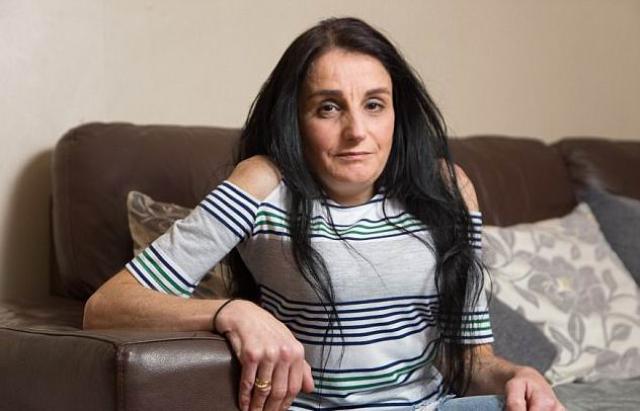
A Life with 100 TumorsLiz Barton, a 47-year-old woman from Richmond, Yorkshire, has been living with over 100 non-cancerous tumors on her body due to a genetic condition called neurofibromatosis type 1 (NF-1). At the age of 16, she underwent surgery to remove a golf-ball-sized tumor from her spinal cord, resulting in a 100-degree curvature known as kyphoscoliosis.

'I Feel Like a Little Hunchback'
Liz, a mother of three, confides, "'I felt like a real freak. Sometimes I feel deformed. For years, I tried to stay out of people's sight, but I don't want to hide anymore.'" The surgery completely altered her life, leaving her with a permanently curved spine protruding from her back.

The Genetic Cause: Neurofibromatosis Type 1
NF-1 is a genetic disorder that causes non-cancerous tumors to grow throughout the body. Liz explains, "'Most of the tumors on my body feel like little peas under the skin. I can pinch and 'roll' the peas around under my fingers.'" She also experiences tumors in her head, which she can feel.

The Life-Altering Surgery
At 16, Liz was rushed to the hospital with severe symptoms, including the loss of feeling in her legs and difficulty speaking. "'I had this huge golf-ball-sized tumor that had attacked my spinal cord,"' she recalls. "'They did it as an emergency but as soon as I woke up, my spine was completely crooked. At a 100-degree angle.'"

The Challenges of Kyphoscoliosis
In addition to the NF-1, the surgery further aggravated Liz's spine curvature, impacting every aspect of her life. "'Since the tumor on my spine, it's really difficult to do anything, because every movement is painful,"' Liz says. "'I feel like my friends who are more able-bodied don't like to have their picture taken with me, because I'm so small and hunched, it would ruin their shot.'"

Regaining Confidence
Despite the challenges, Liz is determined to raise awareness about her condition. She now runs a support group on Facebook for people who struggle with body confidence issues. "'I don't want to hide anymore. I want to educate people about the condition,"' she states. "'I never matured until I was about 17. I was so immature and naive acting for my age.'"

The Impact on Family
NF-1 also affects Liz's children: 14-year-old Elliott and 16-year-old Lucy have inherited the disorder, and her eldest son, 21-year-old Joshua, may also have it. Liz shares, "'My mam had an NF-1, my nana had an NF-1, and my grandnana had an NF-1.'"

Understanding Kyphoscoliosis
Kyphoscoliosis typically affects the thoracic spine, giving it a 'C' shape. In milder cases, it may only cause an unusual spinal appearance, but it can lead to nerve problems and chronic pain. Kyphoscoliosis can occur from birth, after an injury or surgery, or due to osteoporosis. In the case of surgical intervention, a second corrective surgery may sometimes help.
Neurofibromatosis Type 1
NF-1 is a common genetic disorder that affects around 1 in 3,000 people in the UK. It is caused by a genetic mutation that affects the growth of nerve tissue. About half of NF-1 cases are inherited from a parent, while the other half develop spontaneously. Early symptoms may include 'café au lait' spots, raised bumps, and nodules in unusual places. NF-1 can also be associated with slight learning difficulties. Most people with NF-1 are otherwise healthy and have a normal life expectancy. There is no cure, but surgical interventions can be used to remove benign tumors.


