Louis Auguste Victor Ghaisne de Bourmont
 France
- Early Life and Military Career
- Royalist Leader
- Arrest and Escape
- Military Victories and the Bourbon Restoration
- Later Career and Exile
Early Life and Military Career
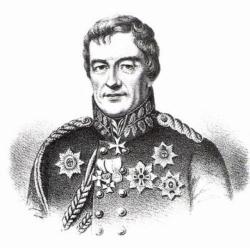
Henri de Bourbon, Comte de Bourbon, was born on September 2, 1773, in his family's ancestral castle. After completing his education at the Royal Military School of Sorèze in 1790, he joined the guard as an officer. At the onset of the French Revolution, he became an aide-de-camp to Prince Condé. In 1795, Bourbon commanded a detachment of Vendéens and was sent to England to request promised reinforcements. Despite the failure of his mission, Bourbon was awarded the Order of Saint Louis for his loyalty to the Bourbon monarchy.
Royalist Leader
In 1799, after the royalist cause suffered setbacks, Bourbon reinvigorated the movement, adopting the pseudonym "Renardin." He commanded a 2,000-strong detachment of Manceu Chouans and captured the city of Le Mans on October 16, 1799. After a period of pacification in northwest France, Bourbon traveled to Paris and entered the service of the First Consul.
Arrest and Escape
However, Bourbon was implicated in a plot to assassinate Napoleon Bonaparte known as the Infernal Machine plot. He was arrested and imprisoned in the Besançon citadel for three and a half years. In 1804, he escaped and fled to Portugal, where he remained until 1808. Upon his return to France, Bourbon presented himself to Napoleon, who recognized his valor and appointed him chief of staff of the 2nd Infantry Division in the Italian army.
Military Victories and the Bourbon Restoration
Bourbon distinguished himself in battle in 1813 and 1814, earning the Order of the Legion of Honour and the rank of divisional general. Upon the return of the Bourbons in 1814, he joined their cause and was awarded the Grand Cross of the Legion of Honour. During the Hundred Days, Bourbon initially supported Napoleon but later abandoned him.
Later Career and Exile
After the restoration of Louis XVIII, Bourbon was appointed to various military commands. He later served as commander-in-chief in Spain and was made a peer of France. However, his strict policing measures drew the ire of the populace. He returned to France in 1840 after an amnesty and died on October 27, 1846, in his castle in Inxent.