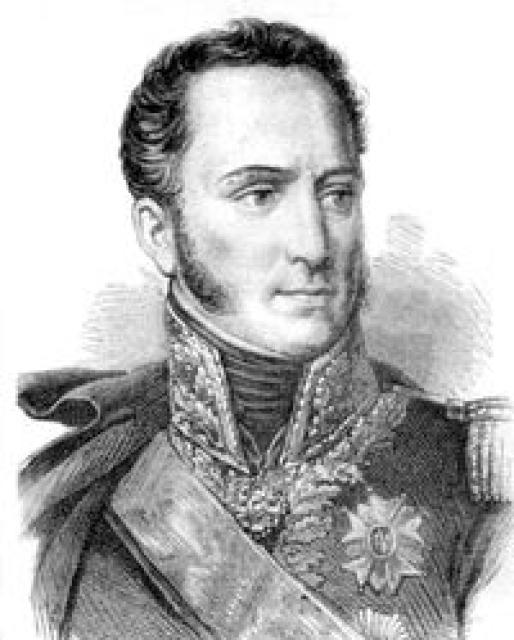
Louis Caulaincourt
 France
- Early Life and Military Career
- Revolutionary Period
- Ascension to Prominence
- Controversial Involvement
- Imperial Service
- Ambassador to Russia
- The Napoleonic Wars
- Foreign Minister
- Hundred Days
- Later Life and Legacy
Early Life and Military Career
Armand Augustin Louis de Caulaincourt was born into French nobility on December 9, 1773, in Caulaincourt Castle, France. He received a private education before joining the Royal Cavalry Foreign Regiment in 1788 as a private. In 1792, he was dismissed from the army as a captain due to his aristocratic background.
Revolutionary Period
Undeterred by the political turmoil of the French Revolution, Caulaincourt volunteered for the National Guard in 1792 and later joined the 16th Cavalry Regiment. However, he was arrested as a "suspicious aristocrat" and escaped from prison, climbing the ranks in the army once again.
Ascension to Prominence
In 1801, Caulaincourt was entrusted with a mission to St. Petersburg, where he congratulated Tsar Alexander I on his ascension to the throne. This successful mission won Napoleon's favor, leading to Caulaincourt's appointment as one of Bonaparte's eight adjutants in 1802 and as a brigade general in 1803.
Controversial Involvement
In 1804, Caulaincourt was ordered by Talleyrand to demand the disbandment of emigrant military formations in Baden. This assignment became infamous as it served as a cover for the kidnapping of the Duke of Enghien, a crime that severely damaged Caulaincourt's reputation.
Imperial Service
Despite the controversy, Caulaincourt was promoted to divisional general and awarded the Grand Eagle of the Legion of Honor in 1805. He was appointed Master of the Horse in 1804, supervising imperial etiquette and managing the emperor's stables.
Ambassador to Russia
In 1807, Caulaincourt was appointed ambassador to Russia. Despite his efforts to maintain good relations between Napoleon and Alexander I, tensions escalated, leading to Caulaincourt's resignation in 1810. He remained in the Spanish army but continued to hold the ambassadorial title.
The Napoleonic Wars
Caulaincourt rejoined the French army in Russia in 1812, where his younger brother was killed in the Battle of Borodino. He accompanied Napoleon on his retreat from Moscow in December 1812.
Foreign Minister
From 1813 to 1814, Caulaincourt served as Foreign Minister, securing Elba as Napoleon's exile. He was instrumental in negotiating Napoleon's abdication and married his long-time love after the emperor's departure.
Hundred Days
During the Hundred Days, Caulaincourt rejoined Napoleon, serving again as Foreign Minister. He unsuccessfully attempted to negotiate a peace with Europe and was briefly elected to the provisional government after the Battle of Waterloo.
Later Life and Legacy
Following the second Bourbon restoration, Caulaincourt was spared arrest due to Alexander I's intervention. He retired to private life, leaving behind memoirs of Napoleon's Russian campaign. Published in 1933, these memoirs offer a valuable account of the events from a Bonapartist perspective. Caulaincourt passed away in Paris on February 19, 1827, at the age of 53.