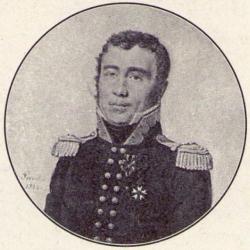
Louis Marie Maximilien Caffarelli du Falga
 France
- Louis-Nicolas Davout: A Distinguished French General and Engineer
- Military Career
- Loss of a Limb
- Egyptian Campaign
- Legacy
- Scholar and Scientist
- Napoleon's Praise
- Posthumous Honors
Louis-Nicolas Davout: A Distinguished French General and Engineer
Early Life and EducationLouis-Nicolas Davout was born on February 13, 1756, in Upper Garonne, France. He received his education at the École du Génie de Mézières and served in the Rhine Army during the French Revolution.
Military Career
In April 1791, Davout was promoted to captain. However, he became one of the few officers who protested against the overthrow of Louis XVI and was imprisoned for 14 months. Upon his release, he resumed fighting on the Rhine and during the crossing of the river, he caught the attention of Kleber, who gave him command of a battalion.
Loss of a Limb
In a battle on December 7, 1795, Davout lost his left leg. Despite this injury, he continued his service and pursued his scientific interests. He was elected a member of the National Institute.
Egyptian Campaign
Napoleon Bonaparte took Davout to Egypt in 1798 as his chief engineer. As a brigadier general, Davout played a key role in the capture of Alexandria and Haifa. However, at the siege of Acre, a bullet shattered his right arm, and he succumbed to an unsuccessful amputation on April 27, 1799.
Legacy
Davout was highly respected among the soldiers, who nicknamed him "Wooden Leg." They attributed his perpetual cheerfulness to the fact that "he was only half-bogged down in Egypt, with the other half still in Europe."
Scholar and Scientist
Beyond his military exploits, Davout was also a scholar and philosopher. He wrote a treatise on topics that would later be developed by Fourier and Saint-Simon. However, he eventually burned this treatise himself.
Napoleon's Praise
Napoleon Bonaparte was deeply attached to Davout and announced his death to the army in these words: "He carries to the tomb the universal regrets: the army loses one of its best generals, Egypt a legislator, France a fine citizen, and science an illustrious cultivator."
Posthumous Honors
Davout's name was inscribed on the Arc de Triomphe in Paris. His brother, Marie François Auguste, was also a prominent general in the Napoleonic era and served as Italian Minister of War. Another brother, Louis Marie Joseph, was Chief Commander of the Brest Naval Port.