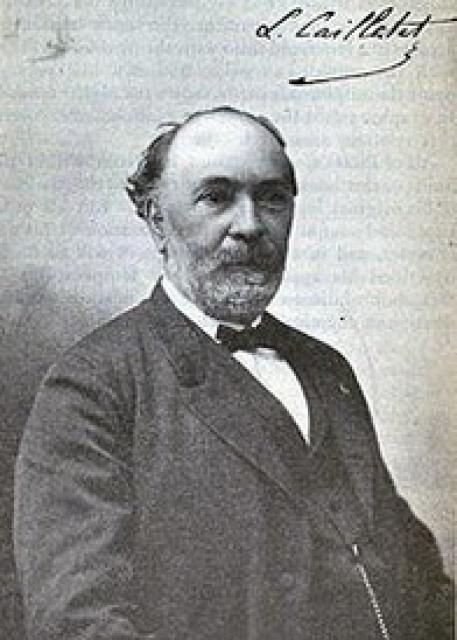
Louis Paul Cailletet
 France
- Louis Paul Cailletet: Pioneer in Gas Liquefaction
- Academic Career and Election to the Academy
- Liquefaction of Gases
- Repeated Experiments and Confirmation
- Liquid Oxygen and the Race for Discovery
- Priority Dispute
- Cailletet's Prior Disclosure
- Later Life and Legacy
Louis Paul Cailletet: Pioneer in Gas Liquefaction
Early Life and EducationBorn in Châtillon-sur-Seine, France, Louis Paul Cailletet initially pursued his father's business, overseeing ironworks. However, his fascination with metallurgy led him to publish several works in the "Comptes rendus" of the Paris Academy of Sciences.
Academic Career and Election to the Academy
After graduating from the École des mines, Cailletet dedicated himself to research. His contributions to metallurgy and his innovative spirit paved the way for his election to the Paris Academy of Sciences in 1884.
Liquefaction of Gases
Initial Experiments and the Unexpected ObservationCailletet's quest for gas liquefaction began with high-pressure experiments using acetylene. However, a leak in the apparatus during one experiment led to an intriguing observation: a brief cloud formed within the vessel.
Repeated Experiments and Confirmation
Undeterred, Cailletet repeated the experiment with pure acetylene and observed the cloud again. This time, he concluded that he had witnessed the condensation of acetylene.
Liquid Oxygen and the Race for Discovery
Building upon his success, Cailletet turned to the liquefaction of atmospheric gases, starting with oxygen. By applying high pressure and cooling the gas with evaporating sulfur dioxide, he managed to observe the formation of liquid droplets.
Priority Dispute
On December 24, 1877, Cailletet presented his findings on liquid oxygen to the Paris Academy of Sciences. However, he learned that another physicist, Raoul Pictet, had sent a report on the liquefaction of oxygen two days earlier.
Cailletet's Prior Disclosure
Despite Pictet's report, Cailletet had sent a detailed letter describing his experiment to his friend, Henri Sainte-Claire Deville, on December 2. Deville promptly delivered the letter to the Academy, ensuring Cailletet's priority as the first to achieve gas liquefaction.
Later Life and Legacy
Cailletet continued his research until his passing in Paris on January 5, 1913. His pioneering work in gas liquefaction laid the foundation for refrigeration, industrial gas production, and cryogenic engineering. Cailletet's legacy endures as a testament to his scientific ingenuity and determination.




