Louise Elisabeth Vigee Le Brun
 France
Biography of Louise Elisabeth Vigée-Le Brun
Louise Elisabeth Vigée-Le Brun was a French portrait painter who gained immense fame and recognition for her artistic talents. She was born in Paris, France, in 1755. Her father, Louis Vigée, was a relatively unknown artist, and her mother worked as a hairdresser. From a young age, Louise showed a talent for drawing and received guidance from her father. After his death when she was twelve years old, she continued her artistic education at the Louvre gallery.
By her teenage years, Louise was already painting portraits professionally, despite the lack of formal education. She had a natural talent and was able to earn a living through her art. On August 7, 1775, Louise married Jean-Baptiste-Pierre Le Brun, a painter, engraver, and art dealer. The marriage was arranged by her mother, and although it did not bring her happiness, it allowed Louise to gain access to aristocratic households. She worked diligently, assisting her husband in his business endeavors, which were not particularly successful. Nevertheless, Louise welcomed the opportunity to have more work, which served as a distraction from her personal disappointments.
In a significant turning point in her career, Louise received a prestigious commission to paint a portrait of Queen Marie Antoinette at the Palace of Versailles. Marie Antoinette was extremely pleased with the portrait, and as a result, Louise was accepted into the Royal Academy of Painting and Sculpture in 1783. The queen not only bestowed upon her the title of the official portraitist but also developed a close relationship with Louise. They would sing duets together and go for walks, forming a bond beyond their professional association.
Throughout the 1780s, Vigée-Le Brun traveled extensively throughout Europe, painting numerous important portraits, including those of royal figures and the European aristocracy. By this time, she was already a highly renowned and celebrated artist, welcomed and honored wherever she went. She became a member of several artistic academies in different countries.
On February 12, 1780, Vigée-Le Brun gave birth to a daughter named Jeanne Julie Louise, also known as Julie. During the French Revolution, she spent more than five years abroad, including a significant period in Russia. She returned to France in the early 1800s after the revolution had subsided.
In her later years, Vigée-Le Brun lived a life surrounded by respect and fame. She continued to paint portraits and wrote her memoirs. Her memoirs, titled 'Souvenirs de ma vie,' were first published in 1835 and were subsequently reissued multiple times. According to her own records, Vigée-Le Brun created 662 portraits, 15 historical and allegorical paintings, and 15 landscapes.
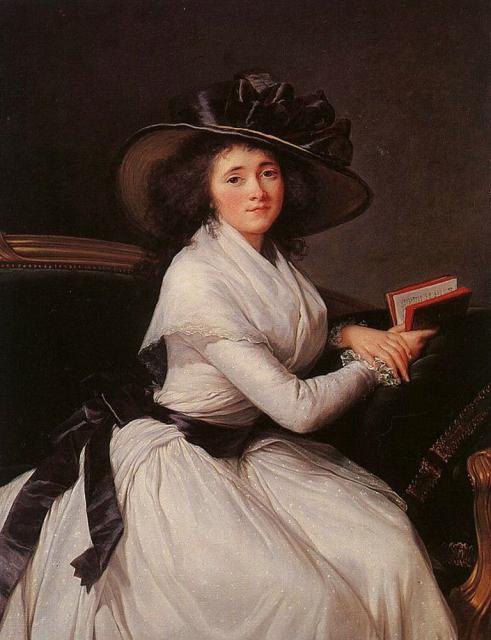
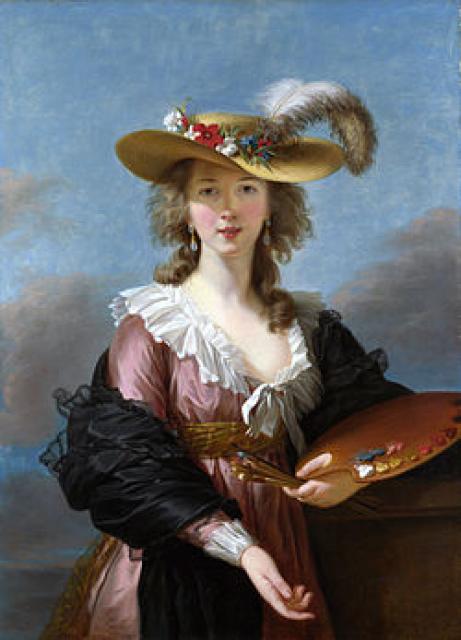
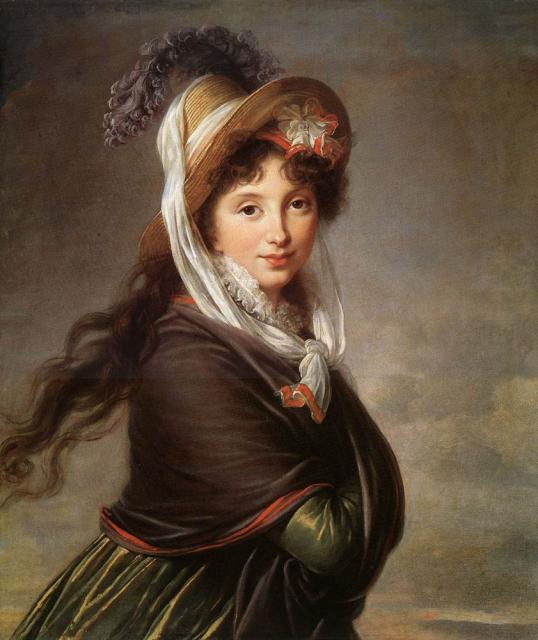
Her style of painting was characterized by elegant and meticulous drawing, harmonious coloration, and a free approach to brushwork. One of her most famous paintings is her self-portrait titled 'Self-Portrait with a Palette' from 1790, which is now housed in the Uffizi Gallery in Florence. In the painting, Vigée-Le Brun is depicted holding a brush in hand, working on one of the portraits that made her famous. She was also known for her exceptional beauty, with a calm gaze and a captivating smile.
Among her other notable works are 'Marie Antoinette, Queen of France' (1786), 'Hubert Robert' (1788), 'Prince Henry Lubomirski as Genius' (1789), and 'Madame de Stael' (1809).
Louise Elisabeth Vigée-Le Brun passed away on March 30, 1842, in Louveciennes, at the age of 86.


