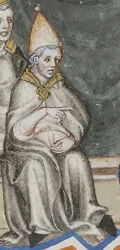
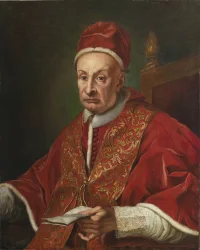
Lucius II
Lucius II was pope for less than a year, during a period when the Roman Commune challenged the papacy’s authority over the city. As Rome’s citizens and nobles pressed for self-government, Lucius struggled to maintain the pope’s temporal power while also negotiating with King Roger II of Sicily and seeking support from the German king Conrad III. His brief reign ended amid the conflict over control of Rome.
A career in the church
Born Gherardo Caccianemici in Bologna, Lucius entered church service as a canon regular before rising through the papal administration. He became a cardinal and served as a papal representative in Germany, where he worked during the negotiations that led to the Concordat of Worms in 1122. After the death of Pope Celestine II, he was elected pope on 12 March 1144 and took the name Lucius II.
The Roman Commune
Rome’s political landscape was changing. In 1143, citizens and nobles had revived the Senate and established a commune that sought greater independence from papal rule. The movement reflected both the desire for self-government and wider political ideas about Rome’s republican past. Reform preacher Arnold of Brescia was associated with the period’s criticism of clerical wealth and temporal power, though the Roman movement had broader civic and political causes.
Lucius tried to defend the church’s governing rights in the city. He sought military and political support from Conrad III, but the king did not arrive in time to assist him. The pope also negotiated with Roger II of Sicily at Ceprano in 1144, attempting to secure the interests of the Papal States and define the king’s obligations toward the Church.
A failed assault and a short pontificate
In early 1145, Lucius led a small force against the Capitol, where the Roman Senate had established its authority. The attack failed. Some later accounts say that he was struck by a stone during the fighting and died from his injuries, though the circumstances of his death are not entirely certain. He died in Rome on 15 February 1145, after a pontificate of about eleven months.
Lucius was succeeded by Eugenius III, who faced the same challenge from the commune. The conflict illustrates that medieval popes were not only spiritual leaders but also rulers whose authority depended on alliances, resources, and the consent—or submission—of the people they governed. Lucius’s short reign left that struggle unresolved, and Rome’s republican movement continued to shape papal politics in the years that followed.