Manuel Azana
 Spain
SpainBiography of Manuel Azana
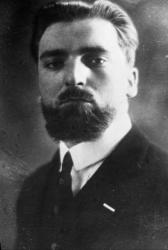
Manuel Azana, an influential Spanish politician and writer, served as the President of Spain from 1936 to 1939. Born into a wealthy family, Azana was orphaned at a young age. He completed his education at the College of the Order of Augustinians in El Escorial, although he later distanced himself from religious beliefs. Azana obtained a law degree from the University of Zaragoza in 1897, followed by a doctorate in law from the Central University of Madrid in 1900.

In his early career, Azana worked as an assistant to the lawyer Luis Diaz Cobeña. At the same time, he was involved in an unsuccessful venture to establish an electric factory. After losing his fortune, Azana found employment in the registration and notary department in 1910. He continued his education in Paris from 1911 to 1913 and worked as the secretary of Ateneo, a liberal literary, scientific, and artistic society in Madrid from 1913 to 1920.
Azana published his works in El Imparcial and El Sol newspapers and became a member of the Reformist Party in 1914, which was led by Melquiades Alvarez. During World War I, he worked as a correspondent in France, including reporting from the front lines. His articles had a strong pro-French direction. In 1918 and 1923, Azana unsuccessfully ran for parliament from Toledo. In 1918, he participated in the creation of the Spanish Democratic Union, but after the failure of this political project, he returned to France and worked as a journalist for the newspaper Figaro. From 1920 to 1924, Azana edited the journal Pluma, and from 1923 to 1924, he edited the journal España. He married the sister of his colleague journalist Cipriano Rivas Cherif.
Azana was also a well-known writer and authored several literary works, including "Vida de don Juan Valera" (1926), for which he was awarded the National Literature Prize, "El Jardín de los frailes" (1926), and "La invención del Quijote y otros ensayos" (1934). Additionally, Azana translated works by George Borrow, Bertrand Russell, and Stendhal, and he engaged in literary criticism and essay writing.
In the 1920s, Azana was oppositional to King Alfonso XIII and dictator Miguel Primo de Rivera. In 1924, he published a strong appeal against the dictatorship. In 1926, together with José Giral, he founded the Republican Action Party. In 1930, Azana became the president of Ateneo, showcasing his influence among Spanish liberal intellectuals. He participated in the signing of the San Sebastian Pact in 1930, symbolizing the unity of all republican political forces.
After the overthrow of the monarchy in April 1931, Azana became the Minister of War in the temporary government of the republic. From October 1931 to September 1933, he simultaneously served as the Prime Minister, succeeding Alcala Zamora due to disagreements with the majority of the government regarding the treatment of the Catholic Church. During his government, Azana implemented an anti-clerical policy, which included the separation of church and state, the discontinuation of state salaries for priests, and the prohibition of monastic orders that took additional vows beyond the three usual ones. The Azana government received support from Masonic organizations, which were centers of liberal society in Spain, and Azana himself became a Freemason in 1932. His government enacted agrarian and educational reforms, closed church schools, and established numerous secular schools. Azana also initiated military reforms and reduced the number of generals in the army to align with the army's size.
In 1932, Azana successfully suppressed a military rebellion led by General José Sanjurjo, known as the "Sanjurjada," which further strengthened his position. However, the execution of anarchists opposing the government in the village of Casas Viejas in January 1933 disillusioned many republicans who previously supported Azana. The municipal elections in 1933 resulted in a defeat for the government parties, leading to the resignation of Azana's government in September of the same year and the holding of early elections.
During his time in government, Azana continued his literary pursuits and wrote the play "La Corona" ("The Crown"). After the victory of center-right forces in the parliamentary elections in November 1933, Azana briefly stepped away from politics and wrote the book "In Power and in Opposition." In 1934, he became the leader of the newly formed Left Republican Party, which brought together Republican Action, Radical-Socialists, and the Galician Republican Autonomous Organization. In the same year, he was arrested on charges of inciting rebellion in Barcelona with the aim of proclaiming a Catalan state. On November 14, 1934, a large group of liberal and left-wing intellectuals, including Federico Garcia Lorca, protested against the treatment of Azana by the government. He was released by the court in 1935, and he described these events in his book "My Uprising in Barcelona."
In late 1935, Azana played an active role in the creation of the left-wing coalition Popular Front, which won the extraordinary parliamentary elections in February 1936. From February to May 1936, he served as the Prime Minister, and after the removal of President Alcala Zamora, he succeeded him as the President on May 10, 1936. The start of the Spanish Civil War in July 1936 dealt a severe blow to Azana's position, as his role as president became increasingly nominal. He had significant disagreements with Socialist Prime Ministers Francisco Largo Caballero and Juan Negrin.
Coming to the conclusion that the Republicans could not win the war, Azana advocated for a compromise with the Francoists. On July 18, 1938, he delivered a speech before parliament demanding reconciliation under the slogan "Peace, Mercy, Forgiveness." However, he remained unacceptable to the Nationalists, as he was associated with the main Republican reforms. In February 1939, after the Republicans lost control of Catalonia, Azana went into exile in France. On February 27, he announced his resignation, which contributed to the loss of legitimacy of the republic's authorities. He lived in exile in France and passed away on November 4, 1940, heavily aged and burdened by the challenges of his life. Before his death, he received the sacrament from the bishop of Montauban, returning to the fold of the Catholic Church.
The Vichy government banned Azana's burial with presidential honors, allowing only the covering of the coffin with the Spanish flag, but the two-color flag used during the monarchy and Franco's rule, not the three-color republican flag. In response, the Mexican ambassador ordered the coffin to be covered with the Mexican flag, stating to the French prefect, "For us, it will be an honor, for republicans, hope, and for you, a painful lesson."
Currently, the Manuel Azana Association exists, which owns a bookstore and organizes cultural events. Every year in November, the "Days of Manuel Azana" are held. Azana's posthumous memoirs were published, serving as an important document in understanding the history of 1930s Spain.