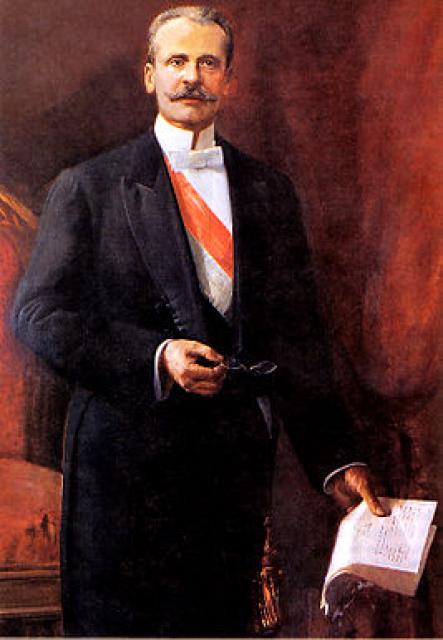
Manuel Iriarte
 Peru
Peru- Manuel Irigoyen - Peruvian Politician and President
- Early Life and Career
- Political Involvement
- Defense of Lima and Deportation
- Later Political Career
- Presidency and Legacy
- Personal Life and Recognition
Manuel Irigoyen - Peruvian Politician and President
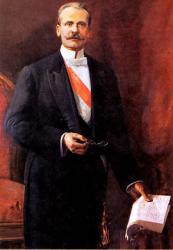
Manuel Irigoyen, also known as Manuel Candamo, was a Peruvian politician who served as the President of Peru from 1903 to 1904.
Early Life and Career
Born in 1841, Irigoyen began his career in journalism at the newspaper "El Comercio" in 1863, one of Peru's oldest newspapers. During his time there, he gained recognition as one of the main critics of President Juan Antonio Pezet and his policies. One of his major points of criticism was the peaceful treaty with Spain after the war, known as the "Vivanco-Pareja Treaty". As a result of his actions, he was exiled to Chile but returned after the uprising led by Mariano Ignacio Prado against President Pezet.
Political Involvement
Following the revolution, Irigoyen became an active supporter of Prado. However, when the Peruvian Congress refused to recognize Prado's government, he left for Chile to work in a diplomatic mission. However, he did not stay there for long and eventually traveled to Europe and Asia. Together with Prado, Irigoyen was one of the founders of the influential Civil Party of Peru. The party aimed to demilitarize power in Peru, as it was mostly controlled by military leaders at the time.
Defense of Lima and Deportation
During the occupation of Lima by Chilean forces, Irigoyen participated in the defense of the capital city. He fought in battles at San Juan and Miraflores. However, after the occupation of Lima, Irigoyen, along with other prominent political figures, was deported to Chile due to their disagreement with the peace treaty that required territorial concessions from Peru. Irigoyen was able to return to the country only after the signing of the peace treaty known as the "Asión Treaty". However, he was once again forced to leave the country due to his support for Caseres against President Iglesias.
Later Political Career
Once Iglesias was overthrown and Caseres came to power, Irigoyen was elected to the Senate. He served as its leader in 1888, 1890, and 1892. In 1894, Irigoyen held the position of mayor of Lima. When Andres Avelino Caceres was forced to step down from the presidency, Irigoyen was chosen to lead the "Temporary Government Junta" until the arrival of the newly elected president, Nicolas de Pierola.
Presidency and Legacy
In 1903, during the presidency of Eduardo Lopez de Romaña, Irigoyen was once again elected as the head of the Senate after the compromise between the main political parties in Peru, the Civil and Democratic parties. He was presented as the most moderate and preferable political figure at that time. However, Irigoyen's presidency was short-lived as he fell ill shortly after his election and passed away. He was succeeded by Vice President Serapio Calderon, followed by Jose Pardo, who became the Minister of Foreign Affairs in Irigoyen's government.
Personal Life and Recognition
Manuel Irigoyen was married to Teresa Alvarez Calderon, and they had two daughters. One of their daughters, Teresa de La Cruz, founded the monastery "Canonesas de La Cruz". In 1981, she was honored with the title of "Servant of God", signifying that her life is being studied by the Catholic Church for possible canonization.