Manuel Noriega
 Panama
- Early Life and Military Career
- Intelligence Networks and the Road to Power
- Military Rule and Growing Crisis
- Trials and Imprisonment
- Legacy
Manuel Noriega rose from Panama’s military intelligence service to become the country’s de facto ruler, balancing ties with Washington against alliances across Latin America. For years, U.S. agencies treated him as a useful intelligence partner; later, his rule became synonymous with political repression, allegations of drug trafficking, and a violent break with the United States. His removal in the 1989 invasion of Panama began a long passage through American, French, and Panamanian prisons.
Early Life and Military Career
Noriega was born in Panama City to a poor family with Colombian roots. The year is disputed: the API record gives 1938, while many biographical accounts and obituaries list February 11, 1934. He attended military school in Peru and returned to Panama in the early 1960s, joining the National Guard. He also received military training at the U.S. Army’s School of the Americas, then based in the Panama Canal Zone.
His career advanced under General Omar Torrijos, who came to power after a 1968 coup. Noriega became an intelligence officer, eventually heading the Guard’s G-2 service. The post gave him access to information about political opponents and influence within the security apparatus. In 1969, he helped Torrijos defeat an attempted coup, a turning point that strengthened the bond between the two officers and elevated Noriega’s standing.
Intelligence Networks and the Road to Power
During the Cold War, Noriega built a complicated relationship with the United States. He supplied information to U.S. intelligence agencies and worked with American officials on regional matters, including the conflict in Nicaragua. Declassified records and later reporting confirm a long-running intelligence relationship, while accounts differ on its scale and the extent of U.S. knowledge of his other activities. His usefulness to Washington would later sharpen criticism of U.S. policy: officials continued dealing with him even as concerns about corruption and drug trafficking accumulated.
Torrijos died in a plane crash in 1981. Speculation that Noriega had a role in the crash has circulated, but it has not been established as fact. Noriega consolidated his position in the military, took command of the Panamanian Defense Forces in 1983, and became the decisive power behind successive civilian governments. Although Panama retained elected presidents, Noriega controlled the security forces and exerted decisive influence over national politics.
Military Rule and Growing Crisis
Under Noriega, opponents faced surveillance, intimidation, and violence. One of the most notorious cases was the 1985 killing of Hugo Spadafora, a physician and outspoken critic of the regime. Spadafora’s mutilated body was found near the Costa Rican border. Noriega was later convicted in Panama in connection with the murder. The regime also used loyalist groups and security institutions to suppress dissent, while reports of corruption and links to cocaine traffickers damaged its credibility.
The U.S. relationship deteriorated as allegations about drug trafficking and Noriega’s conduct became harder to ignore. In 1988, U.S. federal grand juries indicted him on drug trafficking and related charges. Noriega denounced the accusations as political, while U.S. officials pointed to evidence that he had protected traffickers and used Panama as a transit and money-laundering hub. Panama’s 1989 election deepened the crisis: after opposition candidate Guillermo Endara appeared to win, Noriega’s authorities nullified the results and violently disrupted the opposition’s public celebration.
In December 1989, President George H. W. Bush ordered a U.S. invasion of Panama, publicly citing the protection of American citizens, defense of democracy, and the need to bring Noriega to justice. The operation removed him from power but caused deaths and destruction, including among Panamanian civilians, and drew international criticism over its legality and human cost. After taking refuge in the Vatican diplomatic mission in Panama City, Noriega surrendered to U.S. forces on January 3, 1990.
Trials and Imprisonment
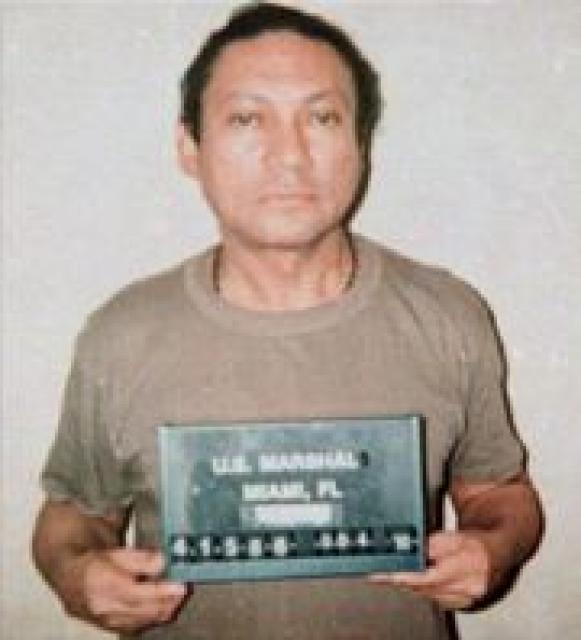
Taken to Miami, Noriega stood trial in federal court. In 1992, a jury convicted him on eight of ten counts involving drug trafficking, racketeering, and conspiracy; he was sentenced to 40 years in prison, later reduced. The trial drew attention for the unusual spectacle of a former head of state prosecuted in the country whose intelligence services had once worked with him. Noriega maintained that he was a political prisoner and challenged the circumstances of his capture, though his conviction was upheld.
After serving most of his U.S. sentence, he was extradited to France in 2010. A Paris court convicted him of laundering money linked to drug trafficking and sentenced him to seven years. France approved his extradition to Panama in 2011. Back home, he was imprisoned for crimes committed during his rule, including the murder of political opponents. In 2017, authorities allowed him to leave prison for house arrest while he prepared for surgery to remove a benign brain tumor. He suffered a brain hemorrhage after the procedure and died in Panama City on May 29, 2017, at 83 according to the commonly reported age.
Legacy
Noriega’s story remains inseparable from the contradictions of Cold War policy. He cultivated foreign intelligence relationships while building a personal power base at home, and a former U.S. partner ultimately became the target of a U.S. invasion and criminal prosecution. For many Panamanians, his rule represents surveillance, fear, and the unresolved grief of political violence; for others, the invasion that ended it remains a source of debate about sovereignty, civilian harm, and the limits of intervention. His rise and fall left Panama with the enduring task of confronting both dictatorship and the consequences of its overthrow.