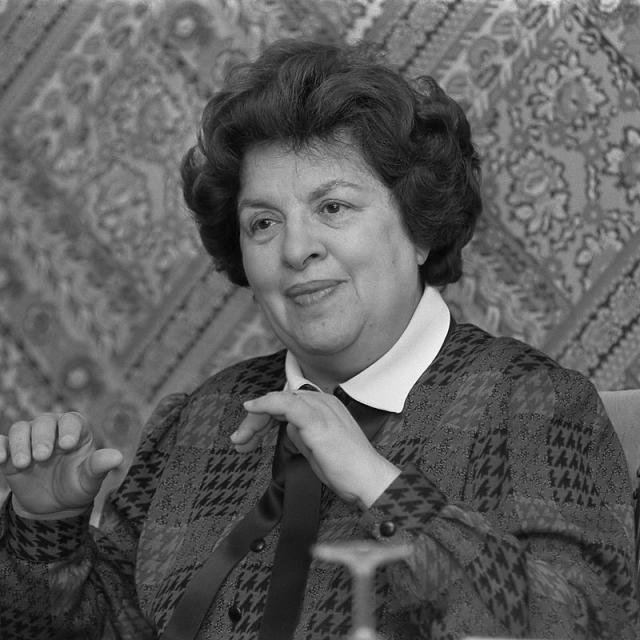
Maria de Lourdes Pintasilgo
 Portugal
- Life and Career
- Professional Achievements
- Political Involvement
- Prime Ministership
- Later Career and Legacy
Life and Career
Maria de Lourdes Pintasilgo was born in Lisbon, Portugal, on January 18, 1920. At a young age, she displayed exceptional abilities, leading to her enrollment at the prestigious Liceu Filipa de Lencastre in Lisbon at the age of seven. She excelled academically and became involved in the Mocidade Portuguesa youth movement founded by the dictator Salazar.
Later, while studying at the Instituto Superior Técnico in Lisbon, Pintasilgo joined the women's branch of the Juventude Universitária Católica, a Catholic university youth organization. In 1953, at the age of 23, she graduated with a degree in chemical engineering.
Professional Achievements
Pintasilgo continued her education after graduating, winning a scholarship through the national nuclear energy program. She subsequently worked for Companhia União Fabril (CUF), one of Portugal's largest cement companies, rising quickly through the ranks. She held the position of senior research and project engineer from 1954 and later became project director, a role she held for seven years before leaving the company in 1960.
Political Involvement
Pintasilgo's strong connection to the Roman Catholic Church led to her involvement in the Catholic University Youth Movement, where she served as chairperson of the women's section from 1952 to 1956 and as leader of Pax Romana, an international Catholic student movement, from 1956 to 1958.
After the Carnation Revolution in 1974, Pintasilgo played a significant role in the provisional governments, serving as Minister of Social Security in both the second and fourth governments.
Prime Ministership
On August 1, 1979, President Ramalho Eanes appointed Pintasilgo as Prime Minister, replacing her predecessor Carlos Mota Pinto. During her tenure from 1979 to 1980, she implemented important reforms in social security, healthcare, education, and labor laws.
Later Career and Legacy
After her time as Prime Minister, Pintasilgo served as Portugal's ambassador to UNESCO and represented the Socialist Party as a member of the European Parliament from 1987 to 1989. She also ran as an independent candidate for President of the Republic in the 1986 election, becoming the first woman in Portugal to do so.
Pintasilgo published several works on the role of the Catholic Church in society and the role of women in politics and public life. She passed away in her Lisbon home on July 10, 2004, from heart failure. As Portugal's first and only female Prime Minister, Pintasilgo remains an inspiring figure in Portuguese history.