Mark Sharpantie
 France
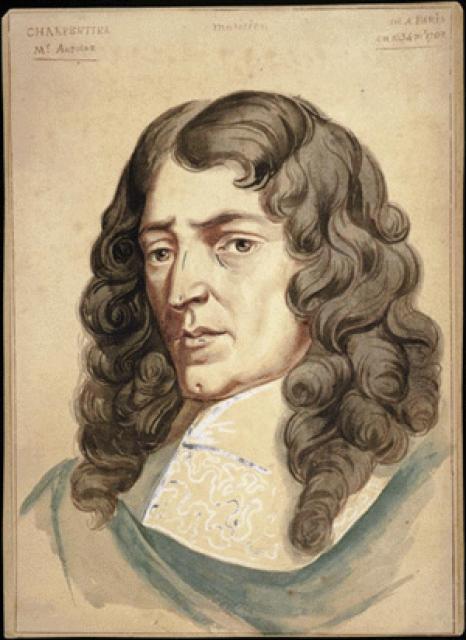
Biography of Marc-Antoine Charpentier
Marc-Antoine Charpentier was a French composer and singer. He was born in Paris to Louis Charpentier, a "maître écrivain" (official document writer) by profession. It is unknown when Marc-Antoine began his musical studies. In the early 1660s, Charpentier traveled to Italy to study painting, but instead ended up studying under Giacomo Carissimi, the most famous Roman composer of the time, for three years.
By the late 1660s, he returned to Paris and entered the service of Marie de Lorraine, Princess of Joinville and Duchess of Guise. Mademoiselle de Guise was a lover of music, and her home constantly hosted musical salons. However, the Guise family was opposed to the royal court, so Charpentier's life remained removed from the musical elite of the era.
In 1672, Molière invited Charpentier to replace Jean-Baptiste Lully in working on his comedy-ballets, including "Le Comte d'Essex," "Le Mariage forcé," "Les Fâcheux," and "Le Malade imaginaire." After Molière's death, Charpentier continued to work in the King's Company, later known as the Comédie-Française from 1682.
In April 1683, eager for recognition, Charpentier participated in a competition for the position of music teachers at the Royal Chapel. Due to illness, he was unable to complete the trials, but he caught the attention of Louis XIV. After the death of Queen Marie-Thérèse in July 1683, Charpentier received commissions to compose music in her memory, including the motet "Luctus de morte augustissimæ Mariæ Theresiæ reginæ Galliæ" and others.
In the early 1680s, Charpentier was appointed responsible for the music at religious services for the Dauphin, and he also taught music to the Duke of Orléans, the future Regent of France. He wrote treatises on composition and accompaniment for the Duke. During one of his visits to the Dauphin, the King was so impressed with Charpentier's music that he refused to listen to anything else until his return to Saint-Germain. In honor of the royal court's move to Versailles, Charpentier composed the divertissement "Les Plaisirs de Versailles."
After Mademoiselle de Guise's death in 1688, Charpentier entered the service of the Jesuits, serving as a music teacher at the Collège Louis-le-Grand on Rue Saint-Jacques in Paris, and later at the Church of Saint-Louis on Rue Saint-Antoine.
During his service with the Jesuits, Charpentier presented his best lyrical tragedy "Médée" at the Royal Academy of Music on December 4, 1693. On June 28, 1698, Charpentier was appointed music teacher at the Sainte-Chapelle, alongside the Cathedral of Notre-Dame, one of the most important institutions in Paris. There, he taught children aged seven to eight, focusing on solfège, vocal technique, sight-reading, and composition.
Charpentier passed away in his home in the Sainte-Chapelle on February 24, 1704. For two hundred years, the name and music of Marc-Antoine Charpentier remained forgotten. Interest in his work was revived in the 1950s when the music from his motet "Te Deum" was chosen as the Eurovision anthem.