Marta Fuchs
 Germany
Biography of Marta Fuchs
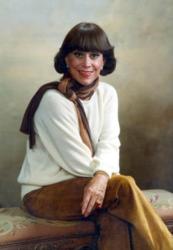
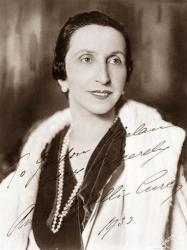
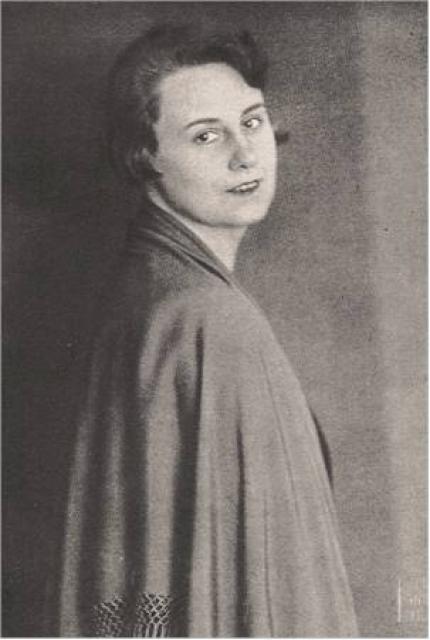
Marta Fuchs was a German opera singer, known for her soprano voice. She was born on January 1, 1898, in Stuttgart. Fuchs received her education in her hometown, as well as in Munich and Milan. In 1923, she had her first concert and spent the first five years of her career performing as a contralto.
Professional Career
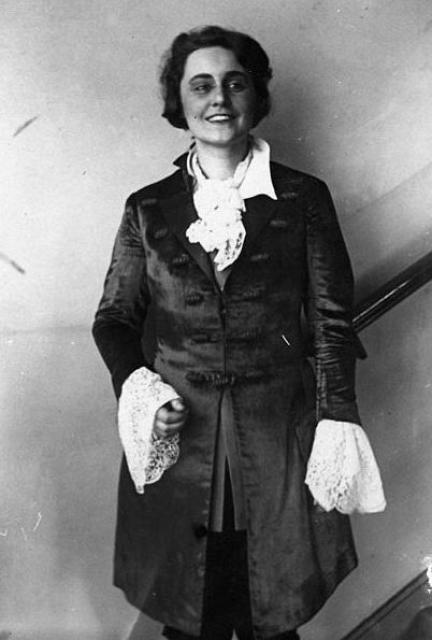
Fuchs made her professional opera debut as a soprano in 1928 at the Aachen Theater. She remained at the Aachen Theater until 1930 when she received an invitation from conductor Fritz Busch to join the Semperoper in Dresden. After further training, it was discovered that Fuchs possessed a high dramatic soprano voice, which suited roles such as the Marschallin in "Der Rosenkavalier," Isolde in "Tristan und Isolde," Brünnhilde in "Der Ring des Nibelungen," Arabella in Richard Strauss' opera, and Fidelio by Beethoven. Her repertoire also included roles such as Octavian, Amneris, Azucena, Eboli, and Ortrud. Fuchs participated in the premieres of several operas, including "Der Günstling" by Rudolf Wagner-Régeny in 1935, where she performed the role of Maria Tudor, and "Die Bürger von Calais" by Mark Lothar in 1939.
Bayreuth Festival and Later Career
From 1933 to 1942, Fuchs became one of the leading Wagnerian dramatic sopranos at the Bayreuth Festival, following in the footsteps of Frida Leider as Brünnhilde and sharing the role of Isolde with her. She also sang the roles of Cornelia in Handel's "Giulio Cesare," Alceste in Gluck's "Alceste," two different Iphigenias, Adriano in "Rienzi," Cherubino and Zerlina, Senta, Elisabeth, Elsa, Venus, Herodias, and Mona Lisa by Max von Schillings. Fuchs performed Donna Anna, the Marschallin, and Ariadne in Covent Garden during a tour with the Dresden Opera Company in 1936. She also toured with the Berlin State Opera in Paris in 1938.
Later Years
In 1941, Fuchs appeared at the Roman Opera as Fidelio. From 1942 to 1944, she performed at the Vienna State Opera, which she left in 1945 and returned to Stuttgart. Until 1951, she occasionally performed in concerts and went on rare tours, but she retired from the stage in 1952.
Despite her popularity and personal acquaintance with Hitler, Marta Fuchs tried to distance herself from the Nazi regime. She passed away on September 22, 1974.