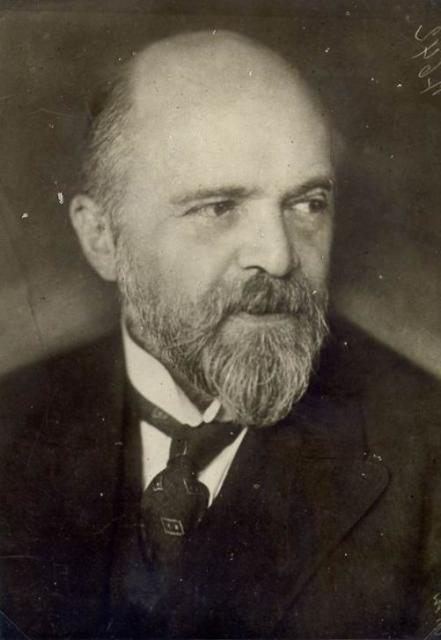
Max Dessoir
 Germany
- The Life and Work of Max Dessoir
- Academic Career
- Parapsychology and the Subconscious
- Aesthetics and Art
- Later Life and Legacy
The Life and Work of Max Dessoir
Early Life and EducationMax Dessoir was born in Berlin, Germany on February 8, 1867. He exhibited an early aptitude for both the arts (violin playing) and the natural sciences. His interest in the intersection of psychology and physiology also emerged during his gymnasium years.
After graduating from gymnasium in 1881, Dessoir studied at the Universities of Würzburg and Berlin. He earned doctorates in medicine and philosophy in 1889.
Academic Career
In 1891, Dessoir joined the University of Berlin as a privatdozent. He defended his dissertation ("Psychologischen Skizzen") for a professorship in 1893 and became an extraordinary professor in 1897. From 1920 until his retirement in 1934, he held the position of ordinary professor at the University of Berlin. In 1947, he resumed teaching as a professor in Frankfurt.
Parapsychology and the Subconscious
Dessoir is recognized as the founder of critical analysis in parapsychological phenomena. Starting in 1885, he conducted systematic observations of mediums, leading him to theorize about the nature of such events based on the concept of the subconscious. His seminal work, "Vom Jenseits der Seele: Die Geheimwissenschaften in kritischer Betrachtung" (1917), introduced the term "parapsychology."
Aesthetics and Art
Together with Eduard Utitz, Dessoir established a school of aesthetics known as "General Science of Aesthetics." Dessoir's concept of aesthetics extended beyond art to encompass nature and everyday life. He believed that art was not solely based on aesthetic sensibilities but also on religious, social, and political factors.
In 1906, he founded the journal "Zeitschrift fur Asthetik und allgemeine Kunstwissenschaft," a central organ for formalist aesthetics. He also organized the first International Congress of Aesthetics in 1913.
In his influential work "Asthetik und allgemeine Kunstwissenschaft in Grundzuge" (Stuttgart, 1906), Dessoir categorized arts into two types: imitative arts (with real forms such as space and time) and free arts (with irrelevant forms such as architecture and music).
Later Life and Legacy
Max Dessoir died in Königstein, Taunus, Germany on July 19, 1947. He left behind a legacy as a pioneering thinker in parapsychology and a influential figure in aesthetics. His work continues to shape these fields to this day.