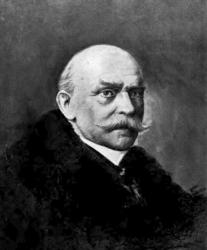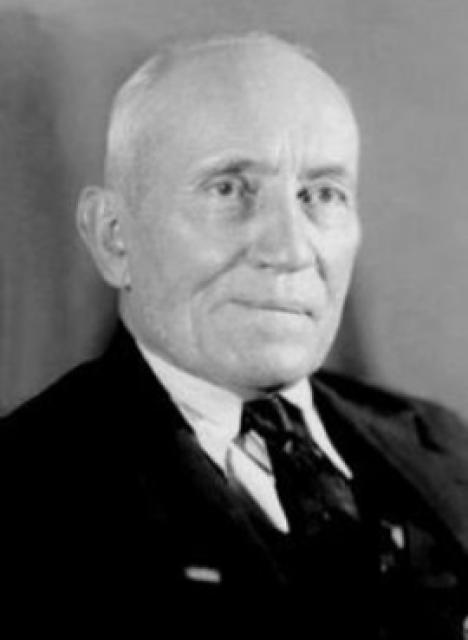
Mihail Andreev
 Uzbekistan
- Origin and Early Education
- Exploration and Research
- Collaboration with Polovtsev
- Oriental Studies
- Relocation to St. Petersburg
- Service in India
- Exploration of the Himalayas and Pamirs
- Academic Career and Explorations
- Founding the Turkestan Oriental Institute
- Membership in the Academy of Sciences
- Later Years
- Legacy
Origin and Early Education
Mikhail Stepanovich Andreev was born on September 24, 1873, in Tashkent, Uzbekistan. He was the grandson of a soldier. Growing up in the old city district, Andreev developed an interest in Central Asian culture and languages. He attended the Tashkent Gymnasium and later the Tashkent Teachers Seminary.
Exploration and Research
During his seminary years, Andreev explored the surrounding areas, including the Kyrgyz nomadic communities. He also familiarized himself with Persian, Arabic, and Turkish literature. After graduating from the seminary, Andreev continued his exploration by traveling to various regions of Central Asia, including the Angren Valley, Fergana Valley, and the Pamir Mountains.
Collaboration with Polovtsev
In 1896, Andreev joined Arkady Polovtsev, an official in the Ministry of Internal Affairs, as his secretary. Polovtsev's influence allowed Andreev to expand his research activities and travel extensively in the Transcaspian region and Caucasus.
Oriental Studies
Andreev's research in Central Asia gained recognition when he presented his findings at the Turkestan Archaeological Circle. He published his first ethnographical article in 1895, detailing the persistence of pre-Islamic practices among native populations.
Relocation to St. Petersburg
Andreev moved to St. Petersburg with Polovtsev and established connections with prominent Orientalists such as Sergei Oldenburg, Vasily Radlov, and Konstantin Zaleman. He studied French, completed the Oriental studies program at the French National Library, and published research on the ethnography of the Ishkashim and Wakhan tribes.
Service in India
In 1906, Andreev accompanied Polovtsev to Bombay, India, where he served as personal translator and vice-consul. During this period, he collected ethnographic artifacts for the Museum of Anthropology and Ethnography in St. Petersburg.
Exploration of the Himalayas and Pamirs
Andreev's enthusiasm for exploration led him on a hazardous journey across the Karakoram Pass in the Himalayas. He traversed various mountain passes and ethnic territories, expanding his knowledge of Central Asian cultures.
Academic Career and Explorations
Andreev returned to Tashkent after his Indian assignment. In 1911, he was elected a corresponding member of the Bengal Geographical Society. He continued his exploration and research in Central Asia, contributing to the ethnography of Uzbekistan, Tajikistan, and Afghanistan.
Founding the Turkestan Oriental Institute
After the October Revolution, Andreev returned to Tashkent and played a pivotal role in establishing the Turkestan Oriental Institute in 1918. He served as its first director, assembling a talented faculty and expanding its resources.
Membership in the Academy of Sciences
Andreev's academic contributions were recognized when he was elected a corresponding member of the Russian Academy of Sciences in 1929. He also received the gold medal of the Geographical Society in 1928.
Later Years
Andreev continued to organize expeditions and publish throughout his life. He was a member of several learned societies and made significant contributions to the fields of ethnography, linguistics, and archeology.
Legacy
Mikhail Stepanovich Andreev died on November 10, 1948, in Stalinabad (now Dushanbe, Tajikistan). He left behind a rich legacy of research and scholarship that continues to inform the study of Central Asian cultures.